• About
    • Contact
    • Press
    • Sponsor
  • DIY
    • Home & Garden
    • Jewellery & Accessories
    • Yarn Crafts
  • Sewing
    • patternless & self drafted
    • Refashions
    • Commercial Patterns
    • Sewing Tips
    • Overlockers
  • The Refashioners

Portia Lawrie

finished garments, jersey, knits, Sewing

FO x 2: (well 3 technically!) My perfect boxy tee

04/28/17

One might say that this simple boxy tee was nearly 3 years in the making! Why? Because I discovered an abandoned experiment in my stash from that time period. I picked it up…looked at it quizzically….wondered why it had been cast aside because…it looked like just the kind of tee I’d been looking for recently. So I sewed it up in half an hour and what do you know….it was exactly the shape and proportion I had been hankering after in my wardrobe. So I made 2 more!

self drafted box tee (5)

The first being this incarnation in a pique type knit from Stoff & Stil. I love the irregular sketchy arrows and the monochrome makes it a really versatile addition. The top is self drafted….but very simply so. Rectangles for body and sleeves but with a slight curve for the sleeve heads and armholes, and curves cut out for the front and back neckline. My original experimental one was literally just rectangles but I loved the proportions so much that I drafted a pattern and added in those subtle refinements….self drafted box tee (5)self drafted box tee

Then I liked that one so much that I made another! Also in a Stoff & Stil fabric. This is a slightly looser version. But all 3 (the original, which is black, and these two) are in constant rotation. It’s like I had my holy grail of tees sitting in my WIP pile for 3 years! What the heck?!! Revisit your WIPs people! Seriously….you started them for a reason!self drafted box tee self drafted box tee

So needless to say….I will be making a few more of these.

I also want to direct your attention to the neckbands on these babies. Notice they are perfectly turned in and laying flat? Well in the past this has always been a bit touch and go for me. (wavy neckbands anyone? Ack!) But I have been working on a formula for calculating the exact length of neckband you need, for any given neckline circumference….and any given fabric. (You may have read my initial ruminations here!) Because…it seemed to me that I needed to factor in the stretch percentage of the fabric I was using. A fabric with 40% stretch was not going to turn in the same way as a 60% stretch fabric cut to the same length. Well if my last few knit makes are anything to go by…I’ve nailed it! And there will be a post coming your way soon. So if you ever got frustrated at wavy or puckered neckbands….stay tuned!

DIY, Dressmaking, how to, jersey, knits, overlocker, overlockers, serger, Sewing, Sewing Basics, sewing machines, Tips and Tricks, Tutorials, Uncategorized

Serger Series – Part 2: Threading

06/02/15

How to thread a serger at www.portialawrie.co.uk

And so we come to it. If you have been “dreading the threading” I promise it really isn’t as intimidating as it seems at first glance. With the exception of the lower looper, which is a teeny bit fiddly, the rest is super straightforward. I know I for one had built this up in my head to be super scary; (when I was doing my garment construction course I’d always wait until the thing was already threaded and then jump on. Managed to avoid threading an overlocker for my whole time there, lol!) and when I finally took the bull by the horns, I was all “oh!! is that it?!!” This is a long photo heavy post but don’t let that put you off. The process itself takes 5 minutes. I’ve just taken alot of pictures, ha ha! You can click on each image to open seperately and zoom in for more detail 😉

PREPARATIONHow to thread a serger at www.portialawrie.co.uk

You’ll need 4 cones of thread. Thread snips and tweezers. The hook nose tweezers are the most useful and if you’re a butter fingers like me then a second pair is handy too. The trickiest part about threading is accessing some of the teeny spaces where the thread has to run; but with tweezers…its a breeze. I’m using different colours here just for illustration purposes. It’s easier for you to follow the route of each thread that way.

How to thread a serger at www.portialawrie.co.uk

Every machine will come with a threading guide. Either on board like mine, or in the manual. Have it to hand. Note the numbers at the top of the diagram. That is the order in which you thread. So, upper looper (red), lower looper (yellow), right needle (green) and finally, left needle (blue). That’s the order we’re going in. (BTW, If you have a secondhand machine that didn’t come with a manual, or you lost yours, then they are often available for free online as PDF downloads. Check out Manual Owl as a good place to start).

How to thread a serger at www.portialawrie.co.uk

Start by turning all your tension dials to zero. This sets the tension discs inside at their most open position and helps ensure that the thread passes between them when you’re threading.

How to thread a serger at www.portialawrie.co.uk

Pull up the telescopic thread bar at the back….

FIRST STAGE (applies to all 4 thread cones)How to thread a serger at www.portialawrie.co.uk

Position your thread cone on the appropriate spool holder. (We’re starting with the upper looper). Pass the thread through the corresponding loop at the top of the thread bar…

How to thread a serger at www.portialawrie.co.uk

Hold the thread horizontally. The thread from the cone in your right hand and the loose end in your left and slide it up under that hook like part. Then take the loose end and run it in the channel that leads to the tension discs at the front. This part is easy to get the wrong way round which can lead to snapped threads.  Don’t want those!  This little wire thread guide has two upper loops at the top of it and the larger hook/loop that extends down. The thread runs from the thread bar above, under the right loop and the downwards hook/loop first and then runs over the top left loop and into the tension disc channel. Click the image to enlarge and zoom in.

UPPER LOOPER (red channel)How to thread a serger at www.portialawrie.co.uk

The thread then runs along that channel and round to the front where you run it between the two metal tension discs of the tension dial and down into the next part of the channel…

How to thread a serger at www.portialawrie.co.uk

…then snugs into another thread guide underneath…

How to thread a serger at www.portialawrie.co.uk

From there join the  red dots! Each thread position is indicated with a read dot and the thread is held there by a little hook that you pass the thread behind. Once you thread the final part of the upper looper (tweezers are useful there! Also, rotate the hand wheel at the side until the upper looper rotates into the most accessible position) the thread passes under the presser foot and off to the side.

How to thread a serger at www.portialawrie.co.uk

Upper looper done! See the red thread marked “1” on my threading diagram? That’s what we’ve just done. We’re now moving on to the lower looper. Marked “2” with the threading route indicated by the yellow thread. Note to the left of the main threading diagram there are two separate diagrams of the lower looper in close up. As I said, the lower looper is slightly trickier.  To the extent that it warrants it’s own diagram, lol! But fear not. It’s fiddly rather than complex.

UPPER LOOPER (yellow channel)How to thread a serger at www.portialawrie.co.uk

The steps up until this point are identical to the red upper looper. To recap: from the thread cones, through the thread bar and rear thread guides, between the tension discs and down into the thread guide underneath…

How to thread a serger at www.portialawrie.co.uk

Follow the yellow dots (in the same way as you did the red for the upper looper), until you get to this point. AKA the slightly trickier part; Rotate the handwheel again so that the lower looper is at its most accessible position, and grab the thread with those hook nose tweezers! In this pic I have hold of the thread with my tweezers and the lower looper, the bit we want to thread, is just behind my tweezers, and just in front of the upper looper. It’s the bit that looks a little like a tiny penknife blade running horizontally behind my tweezrs and it has a little threading hole in the end of it. We need to pass the thread behind it, then over the top of it…

How to thread a serger at www.portialawrie.co.uk

…and then pull the thread towards us until it slides and then slots into a little dip/crevace right on the “elbow” of the lower looper…

How to thread a serger at www.portialawrie.co.uk

Here it is zoomed in a bit. A little blurred (sorry, it was soooo tricky to photograph one handed!) but you can just make out the little nick in the elbow of the upper looper where the thread has to sit….it passes up behind the elbow, over the top and sits in that little cut out/nick….

How to thread a serger at www.portialawrie.co.uk

From there thread the pointy end, and making sure you don’t tangle it with the thread from the upper looper (which sits directly behind it) pass the tail end under the presser foot and off to the side (2 sets of tweezers come in handy here!). Exactly as you did for the upper looper…

How to thread a serger at www.portialawrie.co.uk

Another close up for you. That’s the trickiest part done!!

NEEDLE THREADING (blue and green channels)How to thread a serger at www.portialawrie.co.uk

This part is pretty much the same as a standard sewing machine except you need to do it twice! Start with the right hand needle (green channel). Threading process is exactly the same as the loopers up until the point it passes through the tension discs. Then it goes under a small thread guide, under a slightly larger thread guide and OVER the thread guide marked with the green dot…

How to thread a serger at www.portialawrie.co.uk

Then down to the needles. Right needle is marked A. Into the little pig tail curl …

How to thread a serger at www.portialawrie.co.uk

use tweezers to thread because the cutting blade gets in the way . Especially if you’re right handed…

How to thread a serger at www.portialawrie.co.uk

Then, as with the previous two thread tails; pass under the presser foot and off to the side…

How to thread a serger at www.portialawrie.co.uk

Lastly the left needle (blue channel). Same as the right needle except it only passes under the larger thread guide then OVER the thread guided indicated by the blue dot…

How to thread a serger at www.portialawrie.co.uk

thread and pass the thread tail under the presser foot and off to the side as before.  ****YOU’RE ALL DONE AND THREADED!!*** One last thing to do though. Chain off…

How to thread a serger at www.portialawrie.co.uk

Re-engage your tension discs by setting dials to 3…

How to thread a serger at www.portialawrie.co.uk

Plug in and switch on….

How to thread a serger at www.portialawrie.co.uk

Lower the presser foot and grab hold of your thread tails…

How to thread a serger at www.portialawrie.co.uk

Pull thread tails round to the back, engage the presser foot and serge of a little chain…

How to thread a serger at www.portialawrie.co.uk

Trim any excess and leave a 3″ tail.  All done!! Hope this was useful and that it helps at least someone out there realise that threading a serger is really not as terrible as it first appears. I know this is a photo heavy post which might make this artificially seem like a lengthy process . In reality it takes me 5 minutes, if that! Please please trust me. Try it. And you’ll see 🙂

You can view the first post in this series here.

Next up is tensioning and getting a nicely balanced stitch. I’ve discovered the COOLEST trick for that. Watch this space!

DIY, Dressmaking, fabric, jersey, knits, minerva, self drafted, Sewing, Tips and Tricks, Tutorials

Asymmetric Pleated Tunic

03/12/15

DIY Asymmetric Gathered Tunic at www.portialawrie.co.uk

This mustard knit has been sat in my stash since a few months before we moved last year. I recovered it from storage last week. It is soooooo stretchy and since I didn’t have the right colour cones for my overlocker, I opted to sew this on my standard machine. One word. Aaaargh! But hey…with the aid of a walking foot and a bit of coaxing I got there. The finish isn’t perfect. But in truth this is very much a toile/prototype of an idea I wanted to try out. So in the context of that…I’m content.

Content enough to want to share, because I think in principle, this idea works.  The concept is essentially an easy way to give a shapeless garment definition through simple gathering. So I started by making a shapeless garment! Two simple rectangles sewn together across the top and sides with holes left open for the head and the arms. Not dissimilar to my pashmina refashion…but with less chalking (!) and plenty of width to play with…literally two rectangles…then neckline and armholes finished then hemmed…

DIY Asymmetric Gathered Tunic at www.portialawrie.co.uk

Then I simply pinched out pleats, gathering the excess fabric into one point. Eventually settling on four pleats set off centre just on the lower bust curve. The problem I sometimes have with overly loose tops is that, because I have a largish bust, they have a tendency to hang from the bust point, disguising any shape below the bust and well…just looking a bit “tenty”. Once I’d settled on my arrangement of pleats I simply hand stitched them in place. It provides juuuust enough shaping whilst still allowing me to indulge my love of loose tops!

I could see this being useful for refashioning oversized tops and shirts…..don’t be surprised if you see this technique pop up again basically!

DIY, how to, jersey, knits, refashion, refashioning, repurposing, Restyles, Sewing, sweatshirt, Thrifting, Tips and Tricks, Tutorials, Uncategorized, Upcycling

DIY: Sweatshirt Market Tote Bag

02/23/15

Turn a Sweatshirt into A Tote Bag
This sweatshirt was no longer as slouchy as I would like (one too many tumbles in a too hot dryer…yep!) and was languishing unloved in my wardrobe. So I thought I’d turn it into a handy little market tote, (complete with reinforced handles) ready for my next shopping trip… here’s how….

Turn a Sweatshirt into A Tote Bag

Start by pressing and laying out flat with shoulder seams lined up….

Turn a Sweatshirt into A Tote Bag

Cut off the sleeves using the seams as a guide…

Turn a Sweatshirt into A Tote Bag

Cut a big “U” shape out of the neckline…

Turn a Sweatshirt into A Tote Bag

Turn inside out, remove ribbing, sew opening closed (I curved my corners), then turn right side out again….

Turn a Sweatshirt into A Tote Bag

Now for the handles. Cut 2 x 7″ sections from the ribbing you just removed….

Turn a Sweatshirt into A Tote Bag

Fold in half lengthwise and serge (you could also zig zag or stretch stitch) all the way along the open edge. Look what it does! Cuurves into a perfect handle shape!

Turn a Sweatshirt into A Tote Bag

Feed one side of a handle through the tube…

Turn a Sweatshirt into A Tote Bag

Secure/stitch the 2 handle/strap pieces together…

Turn a Sweatshirt into A Tote Bag

Then slide the tube of ribbing over the join to hide it and distribute evenly. Repeat for both handles….

Turn a Sweatshirt into A Tote Bag

and you’re done!

The beauty of this is that it provides a little more structure and support to what would otherwise be rather stretchy handles, which has kinda what put me off the idea of T Shirt bags in the past. Plus sweatshirt fabric is sturdier to begin with. I think this bag could take a few fresh apples and bananas without breaking into a sweat (unintentional pun 😉

Do you use reuseable shoppers? Handmade or shop bought? My worst habit is actually remembering to take them with me to the shop…doh!

decor, DIY, Future projects, home, Inspiration, jersey, jewelry, knits, Knitting, planning, refashion, refashioning, repurposing, Restyles, Uncategorized, Upcycling

DIY: 21 INSPIRATIONAL IDEAS FOR USING T SHIRT YARN

02/20/15

inspirational t shirt yarn ideasOK, so it’s fair to say I’ve developed a bit of an obsession with making T Shirt yarn. The next question of course is what to use it for! I’ve been browsing the interwebs for inspiration and thought I’d share a few ideas with you, just in case, you know, I’m not the only obsessive in the room….

t shirt yarn ideas

These chunky knit cushions are right near the top of my “To do” list.  A simple knit/purl square on chunky needles with a linen backing. What could possibly go wrong, right?! The ubiquitous T Shirt necklace deserves a mention here. This clutch bag, from what I can gather is knitted from lengths of rubber. No reason it couldn’t work in T Shirt yarn instead though…

t shirt yarn ideas

The idea of a cosy blanket knitted on chunky needles appeals to me right now (instructions here); and I can see potential in this tutorial for crocheted cord being used in a jewelery piece or perhaps as handles for a bag? Now I know this rug is not made from t shirt yarn but a) its lush so I just had to share (and there are other delicious yarn art examples in this post) and b) the concept/technique could surely be applied on a smaller scale with T Shirt yarn?

t shirt yarn ideas

I love copper, grey and simplicity. So this necklace tutorial particularly floats my boat. Again there are other tutorials included in this post from Brit +Co. Love this knitted tote pattern from Daily Fix and surely T Shirt yarn lends itself perfectly to macrame hanging plant holders. Several examples in this post from Censational Girl.

t shirt yarn ideas

I mean seriously, how delicious do these knitted floor cushions look? No tute, but the idea would be simple enough to replicate? I can think of a multitude of uses for these crochet baskets (tutorial here from nimi design.com) and this macrame wall hanging has a simple charm. I’m thinking the technique could also be adapted to form a decorative element for a T Shirt refashion (party in the back anyone?)  or maybe to create a cute string grocery bag?

t shirt yarn ideas

Spoiler alert! Rugs are at the forefront of my plans. This spiral rug from A Beautiful Mess, crochet rug from WhollyKao and woven rug from Viva Le Jar, all employ different techniques to equally cool ends…none use T Shirt yarn but….you could, right?

t shirt yarn ideas

This knitted rug pattern from Purl Bee could surely be adapted for T Shirt yarn. This free pattern for a crochet basket from Ravelry calls for 12mm cotton yarn so could be doable and I like the effect of this rope trivet from Design Sponge. I can’t help but think this nautical style of knotting could be fun to try too…

t shirt yarn ideas

Another slightly more simple knitted bag. I think even I could manage this one. I love the effect of this idea from Oleander & Palm. Simple lengths of coloured yarn hung in volume to great effect; and a random woven belt design that I came across that could totally work!

So, I hope that gives you a few ideas of what to do with your squidgy balls of jersey goodness! I’ve started playing around with knitting mine and have a few ideas in the works….watch this space!

finished garments, hemlock tee, jersey, minerva

FO: My Hemlock Dress

09/27/13

So I had a step by step all photographed for this make. Unfortunately someone, who shall rename nameless, managed to delete all the photos from our SD card. So when I came to write up this post….erm….no photos! Aaaargh! But, I’m sure you’ll get the gist. Let me explain….

This is yet another incarnation of the fabulously versatile and free Hemlock Tee pattern. The fabric is a lovely medium weight jersey with a fine fleecy underside from Minerva Crafts. It’s from their clearance section & priced at £5.99/m. In fact they have a whole heap of jersey on clearance at the moment from as little as £1.99/m. You may have also noticed from my sidebar ads that they are one of my new sponsors….which means if you use the code PORTIA10 at checkout, you’ll get a further 10% off. So if you wanted to recreate a jersey Hemlock dress of your own….hop over there if you fancy a bargain 😉 With a free pattern and discounted fabric, what’s not to love! I would recommend medium to heavy weight jersey for this make. Perhaps even a ponte?

On the subject of how this little number was created, clearly I made a few adjustments:

  • I used the back pattern piece to cut both the front and back pieces of this dress. It makes for a higher, slash neck effect at the front.
  • I lengthened my main pattern piece by several inches.
  • I shortened the sleeve pattern piece so the sleeves are elbow length (I always pull ’em up anyway so why not!)
  • I also shaped the dress so it followed the curve of my body. Not snugly, but it made for a subtly more flattering silhouette in this dress version.

Because of the way the Hemlock Tee is constructed, it is perfect for “pinning to shape”.  The shoulder seams are sewn first. Then the sleeves are attached whilst the fabric is flat (rather than inserted into an armhole). THEN, the sleeves and side seams are sewn in one continuous line. So at THIS stage, rather than stitching as per the instructions, I pinned it to fit me the way I wanted (yes I am a contortionist at weekends) then removed the dress (yes I did stab myself with pins in the process) and used the pins as a guide to draw in my new, more shapely, side seams. Does that make sense?! You could of course pin it so it was much more body con than I have done. Jersey’s great like that!

Man I’m so bummed I don’t have the step by step photos. I was all set to show you the difference between the original seam and the new curvier one AND how I managed to draw in the new seam lines symmetrically on both sides. Also how I achieve a finish similar to an overlocker on my standard machine! But alas, there is no use crying over spilt milk! I shall just have to make another, and next time, guard the SD card with my life!!

BTW, I don’t normally wear dresses. But I can officially confirm HOW comfy this is. I can definitely see a few more of these on the horizon. Quite liberating not having to match seperates! I feel as if I’ve been missing a trick all this time….


hemming, jersey, knits, Sewing Basics, Tips and Tricks

Curved hem “cheat”!

03/11/13

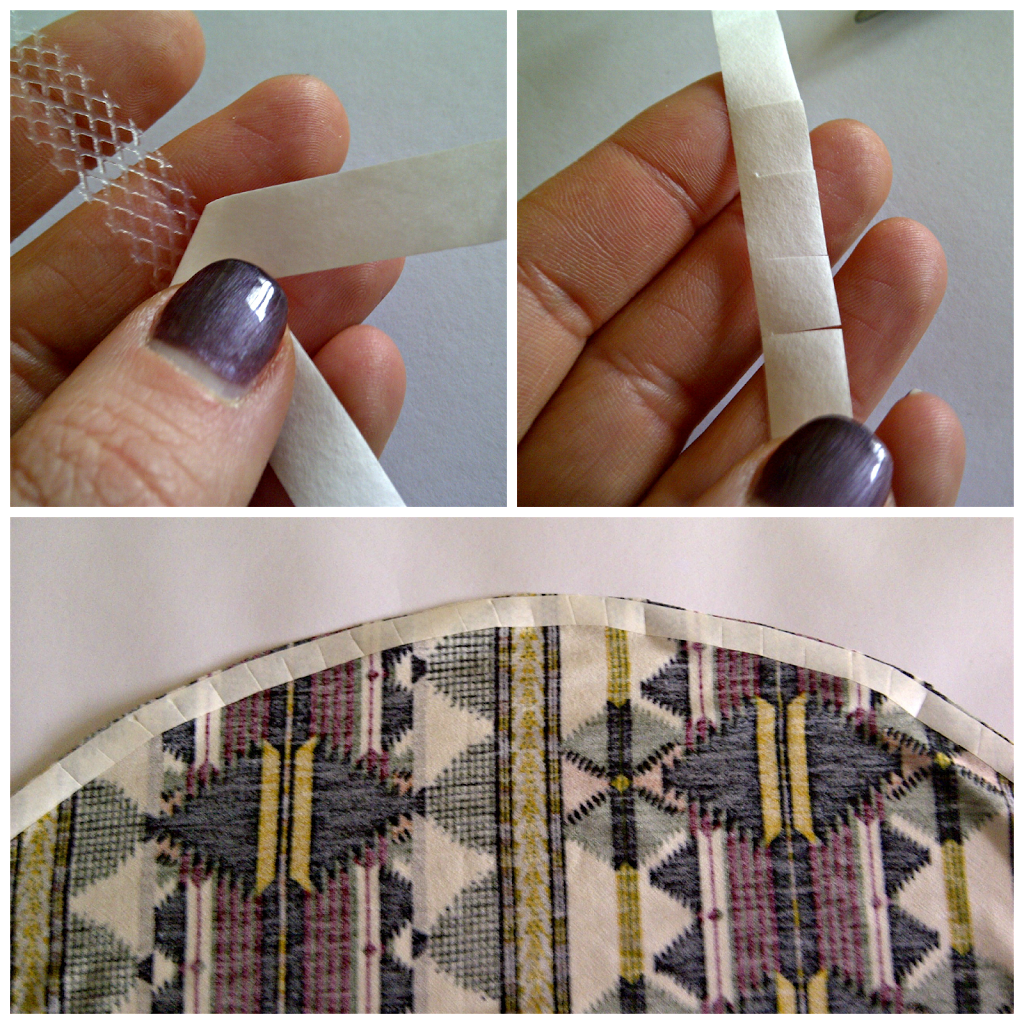
It’s fair to say, I like me a curved hem. It’s also fair to say, I find them a buggar to sew. But last week my college tutor delved into the college stash and pulled out this hemming aid. (I was working on my Aztec top at the time) She had no idea what it was called, or where it had come from. All she knew is that it was bloody brilliant for hemming knits. She demonstrated it on a straight hem sample. Brilliant, I thought! And duly took some home with me to finish my top. Then, as I do alot, I made it slightly more complicated for myself, by deciding I wanted a high/low curved hem (my own worst enemy I am!). And therin lay the challenge that spawned one of my favourite things…..a eureka moment!

I think this stuff is akin to Steam a Seam. Karen goes into more detail here about the overall process of using it. But this “cheat” is primarily concerned with how you get the stuff to go around a curved hem; when it is essentially a straight strip of paper. Hmmmm……

Notching that’s how! After all, don’t we use notching on fabric seam allowances to achieve all those curved elements; like collars, sleeve seams etc. Stands to reason then, that to curve that straight strip of paper backed stuff, notching would do the trick, right? Right! So I notched the entire strip before pressing it to my hem edge. As I worked along the edge I used the notches to manipulate my strip to follow the curved edge of my hem. Worked like a dream! When it came to peeling the paper backing off, it was a bit fiddlier, as essentially I was adhering the strip to itself where the notches overlapped to create the curve. But this was seriously a minor detail. The paper backing still came off fine, just in 3 or 4 pieces rather than one smooth strip. It pressed over beautifully with none of those mini folds/pleats that I often have to fight with when sewing a curved hem. I applied the same technique to my curved neckline too, which was alot easier than facing it or applying binding.  Happy days!

Gonna try this on a woven fabric to see if it’s as effective there. If it is, then I can see this stuff becoming a staple in my sewing supplies. (I really ought to stop calling it “stuff” if we’re gonna have a long term relationship….;)

Portia
Follow
Sewbox

© Copyright 2026. Portia Lawrie. All Rights Reserved. Managed by WordPress Web Dev Cornwall .