• About
    • Contact
    • Press
    • Sponsor
  • DIY
    • Home & Garden
    • Jewellery & Accessories
    • Yarn Crafts
  • Sewing
    • patternless & self drafted
    • Refashions
    • Commercial Patterns
    • Sewing Tips
    • Overlockers
  • The Refashioners

Portia Lawrie

DIY, Uncategorized

FO: Harper Culottes

05/01/20

This week has been a welcome distraction from the current reality or our world. I’ve been digging into the wonderful new book, Sewing Basics for Every Body from the always wonderful Wendy Ward. A collection of patterns for core basics, designed and drafted so brilliantly, that they look great on any gender. Hence the “Every Body” (as opposed to “everybody”) title. Clever huh?

The blog tour started a couple of weeks ago and is being organised by Cico Books  with fabrics provided by George and the team at Fabworks. So far it’s featured Mercedes, Fiona, and  Zoe, So be sure to check them out! Next up is me; and then after that you have the delights of Ben and Elisalex to come.


The book comes with 3 double sided pattern sheets with the pieces for each pattern marked out in their own colour. So first stage of realising any of these patterns is tracing them off.  No pretence here. I hate tracing patterns! BUT I loved Wendy’s designs. They are right up my strata. Relaxed, loose fitting styles with an androgynous feel. I particularly love men’s tailoring on the female form.  Generally the pieces are really easy to make out through Swedish Tracing Paper; even thought it’s a bit of a visual overwhelm when you first clap eyes on it! I opted for the Harper Classic pants though, and THOSE pattern pieces are marked out in a pale grey which was a taddly tricky! But other patterns on the sheet would be pretty easy to make out.

I opted for a gorgeous soft caramel twill from Fabworks. Rather spookily the same one Fiona chose for her wonderful boiler suit. If we ever meet up after the pandemic has passed we could have a matchy matchy coffee date drinking caramel lattes and eating caramel shortbread…

The Harper Classic pants, designed for woven fabrics; are a relaxed fit, pleat front trouser with cut away pockets, fly front fastening and a cinching tab at the back waist. There is a variation for a knit version with drawstring/elasticated waist and a number of variations inbetween if you allow your imagination and creativity to have a play. Which naturally I did because I can never leave a pattern well alone and am compelled to hack everything, lol!

Essentially I squared off the front and back legs as pictured above, and blended with the side seams and inseams to create more of a wide leg culotte shaped trouser. Length wise these are 41cm from the knee line on the pattern piece to the hem. (Including a 1.5cm hem allowance).

I didn’t want to cut my pocket bags from the twill so I used an old shirt that Elliott has outgrown.


However, because they are cutaway pockets I employed a little trick on the underpocket that I’ve picked up from RTW men’s tailoring. (See above). The twill “add on” is a little bit bigger than the part that will be visible behind the cutaway pocket curve. So as far as anyone will be able to see when wearing, it will appear as if my pockets are the same fabric as my trousers. But inside is a gingham check party!

The pattern calls for a couple of d rings for the waist cinching tab at the back. I only had super huge D rings so I adapted and used a waistcoat slider/buckle I had in my stash.

This required a slightly narrower strap than the pattern…..

I’m really pleased with the way the style of the buckle combines with the colour and the fabric to give the whole thing a slight 1940’s military vibe…this detail reminds me of my Dad’s RAF uniform when I was a child.

I went for the same contrasting fabric for my fly shield, as for the pocket bags, a white brass metal zip and a scrap of twill tape as a hanging loop. (I have taken to hanging my trousers on door hooks between wears because I is lazy like dat!) Everything apart from the fabric I made a point of only using what was in my stash because….pandemic.

Genuinely love these trousers AND this fabric. (Even though my resting bitch face would never betray that, lol!) If you haven’t checked this book out yet and, like me, you are a fan of these kinds of relaxed androgynous basics, I thoroughly recommend checking it out. Wendy’s drafting and instructions are meticulous and you’ll be in excellent hands.

DIY, Uncategorized

Simplicity/Eve Appeal Hackalong: Carpenter Jeans

01/17/20

Today I’m taking the baton for the Simplicity Hackalong in aid of the female cancer charity The Eve Appeal. If you’re not familiar with it, essentially Simplicity are harnessing the power of sewing to help raise awareness of the charity and the female cancers it deals with. Use any of the nine patterns from the Simplicity Pattern Hacking range, and join in a WORLD-WIDE SIMPLICITY PATTERN HACK-ALONG to help raise funds, awareness, and be in with a chance of winning some fab prizes. . Share your hack on social media using the category hashtags #hackalongday #hackalongpart or #hackalongvintage. Whichever one best suits your finished garment.

If you don’t use social media you can email your entry (don’t forget to include pattern number and category) to simplicityhackalong@icloud.com

At the end of the Hack-Along Simplicity will select their favourites from your posts in the three design categories. There’s the chance to WIN Sewing or Coverstitch Machines from our friends at Janome and Goody Bags from Simplicity and our sister brands.

Simplicity will be making a contribution to the Eve Appeal for every ‘Hack-Along’ pattern purchased in the UK during the event.

You can find a full list of the patterns included and more deets on whats involved here.

For my own part I opted for Simplicity 8701. Wide-leg fly-front trousers, designed for woven fabrics. Some of the design hacking options this pattern offers include leg length variations, and instructions for distressing denim. I had the most AMAZing barkcloth  weave denim to work with from Minerva Crafts. I also have these cut and ready to sew in a black stretch denim. And seeing as I’m completely in love with these….I’m hoping to finish the black pair within the next week…

For this pair I really wanted to show that pattern hacking doesn’t require you to have in depth pattern cutting skills. Starting with a base pattern, like these hackalong ones, you can completely change the look and feel of a pattern by making simple changes and additions. In this instance I wanted to demonstrate how size and placement of pockets can create a different style of jean to the envelope image. So instead of a 70’s bell bottom vibe…the use of a different style of pocket and topstitching gives these a more Utility/Carpenter jean vibe…

The back pockets are actually the same pattern piece used for the front pockets on the pattern envelope, except I angled the bottom corners a little. The oversized patch pockets positioned at an angle across the side seam are simple rectangles with the edges pressed in…

In order to sew the larger pockets over the side seams, I needed to machine baste the jeans together first to establish and then mark the pocket placement. Then remove all the basting, sew & finish the side seams first (different construction order to the pattern), apply the pockets, THEN sew the inside leg/crotch seam in one pass.

I had a real battle with the top stitching on this one and it can best be described as “rustic”. But actually it really works. And worth bearing in mind that your choice of thread for topstitching details can ALSO afford you th opportunity to hack different looks from the same pattern. I opted for tonal shades of blue and grey to pick up on the colours in the weave. But you could also use traditional orang/gold topstitch thread for a different vibe. Hell, bright red or pink or yellow. Why not?!


I used a metal zip for this make. And a little tip that may well save your machine….use pliers to remove the teeth that fall above the stitching line, before sewing on the waistband.

I also always ALWAYS use Closet Case Patterns fly zip construction method regardless of what the pattern says. It just works. Every time.

And lastly, when working with thick fabric like this denim…it can be helpful to use scraps of folded denim to create “shims” that support the side edge/back of the presser foot  when edgestitching bulky details like pockets. It helps with feeding the fabric through the machine evenly and makes it less of a battle 🙂

So that’s me done! All that remains is for you to get your hack on! Head over to Simplicity for more details, snag yourself a pattern and get hacking!

DIY, Uncategorized

My Denim 3 Quarter Coat (and pillarbox patch pockets!)

04/08/19

This post has been a ridiculously long time coming. I actually made this last summer….JUST before I launched into the craziness of The Refashioners. Meaning to blog it when The Refashioners finished, then finding myself hitting the buffers and screeching to a halt energy wise. (That’s why it’s been pretty quiet around here of late). Now I’ve just dug this denim lovely out again in preparation for spring, it seemed the perfect time to share some details.  Mostly THESE giant pillar box pockets…

They really are the standout feature of this make so the main focus. The rest is pretty standard. I used the pattern hack I did for this jacket as the base, but with wider 3/4 length sleeves; and traced the opening and neckline to create a facing (below) rather than the bound edge with zip fastening.  So it’s an open jacket if that makes sense. The denim (here) is LUSH and has washed and worn beautifully. So far have tried 2 different denims from Sew Essential and both are da bomb!

The facing gives a really simple and clean finish around the neckline and opening….

The cuffs are also faced to add a bit of weight/structure and echo the neckline finish…

Just a band, sew RS together and raw edges aligned with the sleeve hem…

Then flipped out and pressed away from the sleeve (That raw edge will get enclosed in a minute)…

Understitch….ALWAYS understitch…

Then turn and press to the inside….and topstitch from the outside.

Now the pockets. I kinda accidentally did this for the first time while trying to learn how to do a welt pocket. I decided I really liked the effect (Basically a welt pocket without the welt, and a patch combined) and it kinda sat in my subconscious for almost 2 years (!) until I made this.  Essentially, GIANT rectangles with all edges pressed under and machine basted in place. Place a narrow rectangle of fabric RS down and mark and stitch a box as pictured. Mine is about 1cm wide. You could make it wider if you wanted a wider “pillarbox opening” on your pocket. snip down the middle and into the corners….right up to the stitching but not through it…

The fiddly part is flipping that facing through to the wrong side and getting it to lay flat. Lots of steam, pressing and wiggling!

Here’s how it looks from the outside. Like a postbox opening!

I topstitched right around the opening close to the folded/pressed edge. Then another line of topstitching outside of that to echo the twin stitching I had done on the rest of the garment…

The whole “patch” pocket is then pinned in position and all four edges stitched to the garment. So whereas a normal patch pocket would have the top edge open, this one has the top edge sealed and the pillarbox “slit” as your means of accessing the pocket…

A little bit of  subtle “quirk” on an otherwise simple coat…

Also added a little label action to this one (you can tell when I’m pleased with a make, lol!). The scrap of leather can from a sample swatch from a sofa manufacturer…labels from The Dutch Label Shop…

All that’s needed now is some warmer weather here in the UK so I can switch from my winter coat to this beaut! C.mon Spring!!

DIY, Uncategorized

DIY: Wipeable Drafting Board

03/29/19

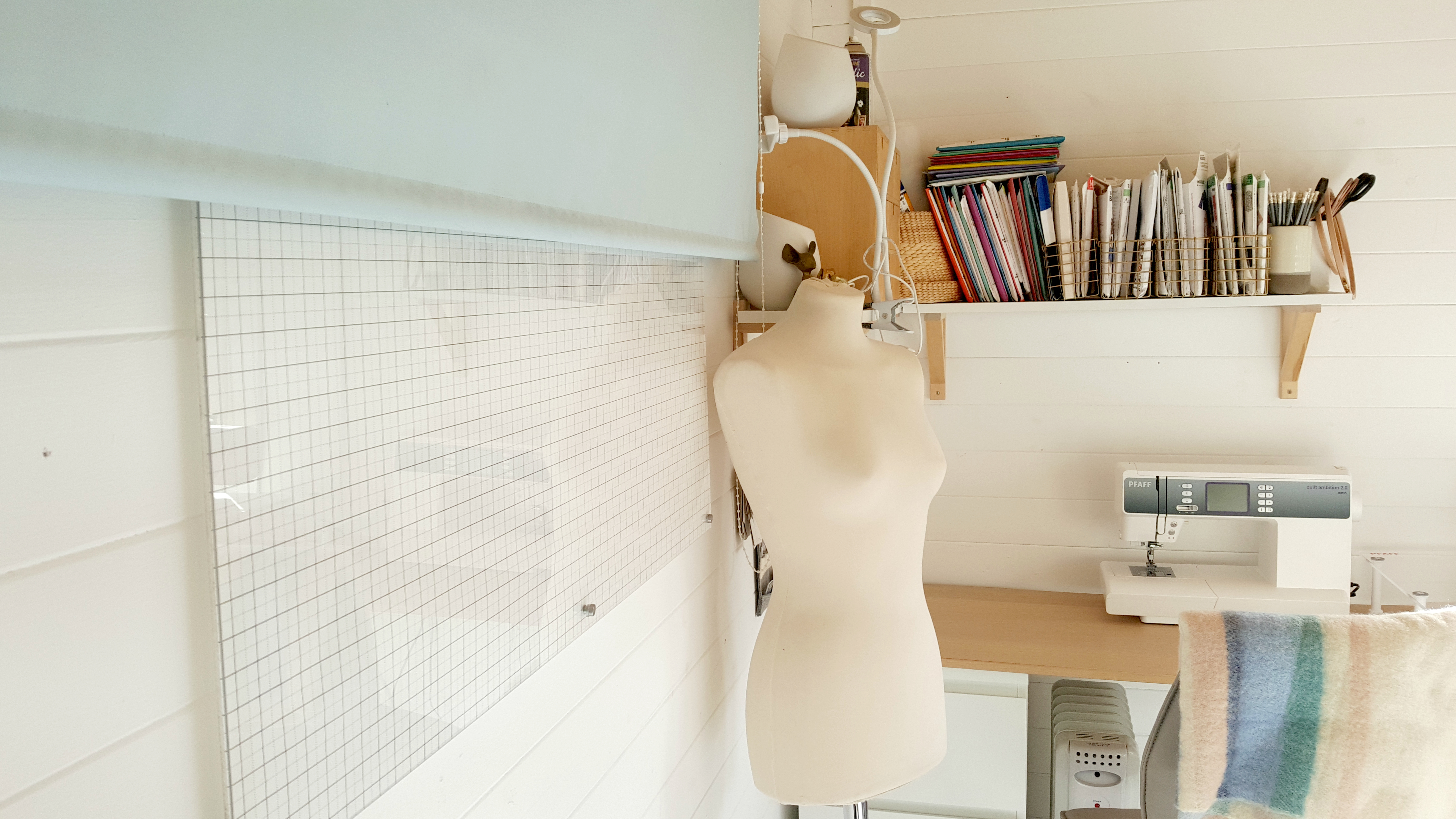
It’s been a while since I made any alterations to my set up in ShedQ. If you want to get more of a feel for my set up and layout you can check out the build and kitting out posts for my space here and here. But before I move onto this particular diy, I ought to mention this big expanse of blue in the picture below….as it’s kinda pertinent to the rest of this post….

Essentially this is a HUGE blackout roller blind that I put up last year and am using as a photographic backdrop. (Click here for the blind I used). Essentially the painted white walls of ShedQ were not providing enough of a contrast to get sufficient definition in some photos so I installed this to address that issue and it works pretty well for that purpose I have to say!

Because of the way a roller blind is mounted there is a decent size recess between it, and the wall. And there….is where today’s DIY is hiding! Like a hidden strategy board in a Bond villain’s lair….

So why a wipeable board? When I’m designing say, a patternless project for the magazine, I like to plan it out first. I’m quite a visual person and often need to draw things out, and figure out measurements and calculations to get the process straight in my head before I crack on with it. Consequently I get through alot of paper which is not ideal. This way, I kind of have a massive sheet of pattern paper that lasts forever and can be used over and over and over again.  It allows me to adjust/tweak/write the whole thing up as I go….full size if I want….without wasting large amounts of paper or scrabbling around on my cutting table for a notebook. I can jot a measurement down…..write a reminder…rejig the order etc. When I’m done….wipe clean and onto the next project. Basically all the benefits of an office whiteboard but the kicker…..it’s made with dressmakers squared paper! So I can draw to scale, plan pattern adjustments etc…

So…here’s how. Materials are fairly straightforward and you can make this any size you want. You can also experiment with different backing materials. As long as the front is acrylic/plexiglass type material so that it’s see through and wipeable. Mine is 1m by 60cm and the sheets for it were supplied cut to that size (they cut them to any size you specify):

100cm  x 60cm backing board (I used this opal 3mm acrylic sheet)

100cm  x 60cm clear perspex/acrylic/plexiglass (I used this clear 2mm acrylic sheet)

Dressmakers squared paper (here)

6 x Stand off wall fixings (here)

Really straightforward. Adhere your paper to the backing board, then trim with a craft knife all along the edges.

I used double sided tape either end BUT if I did this again…I might test out spray adhesive. So the paper is completely stuck down across the whole expanse of the board rather than just where there is a strip of double sided tape (if that makes sense?).

Lay the clear sheet on top. Clamp all layers together . (I  used bulldog clips because it’s what I had to hand)

The aim is to drill a hole the size of the fixing, through all layers. BUT….acrylic needs to be drilled carefully and slowly. You’ll need a drill bit with a really sharp tip like the ones on the left in the pic above. Not the brass or aluminium ones (wood and masonry). You also have  to go slow, drill a pilot hole first with the smallest size drill bit….then work your way up through the drill bits. Gradually enlarging the hole with a larger drill bit at each pass,  until it is the size you want. This, and the masking tape in the image below, will avoid slipping, cracking and chipping and the like.

Now peel back the protective film of the clear top sheet, brush away any drill dust that may have gotten inbetween the layers and insert the “male” part of your fixing. I did this at 6 points (3 along the top and 3 along the bottom) for the size of board I have. So now essentially there is an acrylic sheet sandwich with dressmakers paper in the middle…

The back part of the fixing gets fixed to the wall so the board can be screwed into place like so…

Ta dah!

There are so many variations of this concept I can think of. Obviously this one is for use in my sewing space. But I can see me making a smaller version as a wipeable shopping list in my kitchen….a maths or art board for little man in his bedroom. Or as a decorative rather than functional piece to display precious textiles, kiddo art or family photogaphs.  Also eyeing up old picture frame glass and backing board that could be repurposed using this concept.

I shall be getting through alot less paper anyhow!


Disclosure: This is a sponsored post that contains affiliate links. As always, all views and ideas expressed are entirely my own.

DIY, how to, Sewing, Tutorials

HACK: Cuffed Kimono Tee

03/13/18

This was one of those projects where I just wanted a new top. Fast. I only had a small piece of this gorgeous ponte. Not enough to cut a separate body and sleeves. But I didn’t want e sleeveless top either. A short kimono sleeve is a good workaround and can save the day in these kind of scenarios!HACK: Cuffed Kimono Tee

I lengthened the short kimono sleeves further by adding cuffs made from the off cuts. The waste from this project was practically non existent…HACK: Cuffed Kimono Tee

It’s a simple hack on an existing tee pattern. This is a tracing of the hemlock tee from Grainline. Using the body pieces as a guide I cut a kimono shape outide of the pattern piece. For the shoulder I simply followed the angle of the shoulder line as far as I could (given the limitations of what fabric I had). When it comes to the underarm curve note it’s position in relation to the original underarm point. (Which you can just about make out in this pic. You’ll note that the underarm curve starts 2-3″ below the original underarm point and the sleeve is overall much wider.HACK: Cuffed Kimono Tee

Unfold and use as a template to cut a second identical piece…sew RS together at the shoulders. You can press the seams to the back and top stitch the shoulder seams for a nice finish. (I do this on most of my makes).HACK: Cuffed Kimono Tee

mm

HACK: Cuffed Kimono TeeHACK: Cuffed Kimono Tee

Sew the underarm curves on both sides as pictured….HACK: Cuffed Kimono Tee

Neckline is finished with a simple neckband as per this post…HACK: Cuffed Kimono Tee

Cuffs are loops of fabric the same circumference as your sleeve hems, folded in half WS together…HACK: Cuffed Kimono TeeHACK: Cuffed Kimono Tee

Then pinned to the sleeve hems with raw edges aligned, sewn together and pressed away from the garment, with the SA top stitched in place. I had a little bulk at the point where the underarm seam met the join in cuff . Rather than force it through and make the machine “climb over it” (Even with a shim it never makes for a good stitch); I started the stitch one side of the bulky area and finished it the other side. Topstitching in this instance is really only decorative. So a little gap in the line of stitching, in a spot that won’t be noticeable during wear, is no biggie in my book!HACK: Cuffed Kimono Tee

This has turned out to be one of those fail safe tees. Throw it on for immediate comfort (and hopefully style!) Yook me about an hour to make as my machines were already threaded up wth the right colour thread from my previous make. (Love it when that happens…HACK: Cuffed Kimono Tee

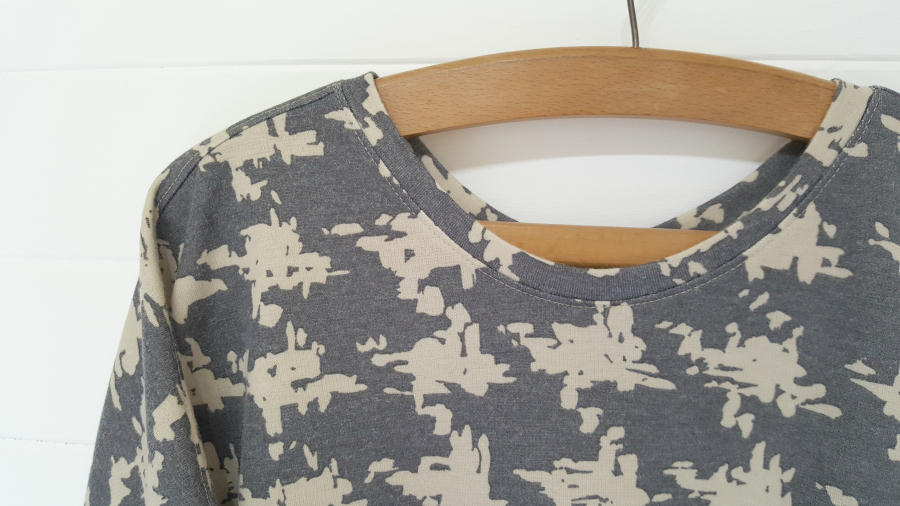
Here’s a close up of that fabric. Lush right? I think it’s out of stock currently but their range of pontes and other jerseys is always ace.HACK: Cuffed Kimono Tee

I like quick projects like this sometimes. Every now and then you just need a quick sewing fix that doesn’t tax the brain too much and gives you a wearable garment at the end!

DIY, how to, Sewing, Tutorials

TIP: Encased Elastic Waistband (another way)

02/26/18

Encased Elastic Waistband (another way)

Really there is nothing more comfy than a wide elasticated waistband is there? It’s also generally regarded to be one of the quickest and easiest of the waistband options to execute. Especially when you’re new to sewing. Now this may just be me, but bear with me here. Yes an encased elasticated waistband is pretty straightforward. But I’ve always found it to be….erm…..fiddly and annoying! Attaching a safety pin  (or similar) to one end of the elastic. Feeding it through  the already sewn casing where it will invariably twist or get snagged on the seam allowances at some point on it’s journey. Wrestling it out the other side and then attempting to get the ends of the elastic under the presser foot with and entire garment hanging off the end of it. And let’s not forget absent mindedly sewing the elastic “twisted” and only realising after you’ve closed up the casing.

Ok that was a bit disproportionately ranty. But if any of it sounds familiar then you too might want to try a different way. Which is how I’ve started constructing my elasticated waistbands recently.

Start with your elastic already sewn together in a loop and your waistband casing also already sewn together in a loop and folded in half. RS out. Your waistband should be the same length as the circumference of the garments wiastline. It should be double the width of your elastic + approx 6mm (thats 3mm either side for wiggle room  for the elastic) + the original seam allowance (usually 5/8″ either side). If you already have a pattern piece for your waistband….use that and simply add 6mm to the width 🙂

Encased Elastic Waistband (another way)

Place the elastic inside the casing with the edge of the elastic butted up to the fold…( I haven’t left quite enough seam allowance here. There’s a better example of the ideal amount of seam allowance a couple of pics further down)Encased Elastic Waistband (another way)

Place under the presser foot. (A zipper foot can be handy here but not vital). Keeping the elastic butted up against the fold sew a long machine basting stitch 3mm away from the edge of the elastic. In this pic you may be able to see I am holding the whole thing at tension and using my thumb to feel where the edge of the elastic is . Keep feeding it through the sewing machine like this. Once you reach a point where there is more casing left than elastic, with the needle down, lift the presser foot. Ruche the casing over the elastic (towards the back of the machine), until the bit you have left to sew lays flat. Lower presser foot. Finish sewing/basting 🙂Encased Elastic Waistband (another way)

You’ll end up with an encased elastic waistband. It just isn’t attached to your garment yet! BUT it’s easier to sew in my view and the bottom edge of the elastic is not going to snag on any seam allowances so should run smoothly through the casing. You’ll also never have that scenario where you accidentally sew the casing a smidge too small for your elastic (which leads to distorted/curling elastic) because you are sewing the casing using the elastic itself as a guide. (This pic is also a better example of the amount of seam allowance left either side of the elastic)Encased Elastic Waistband (another way)

To attach the waistband simply pin to together RS together and raw edges aligned as pictured…Encased Elastic Waistband (another way)

Serge or sew just to the right of your line of basting stitch which should be more or less your original seam allowance…Encased Elastic Waistband (another way)

Once waistband and garment are sewn together, and the raw edges finished, press the SA down towards garment, remove basting and your done!Encased Elastic Waistband (another way)

This will work on wovens or knits. The only caveat is to be careful using this with pockets that are secured at the waistline as this could create a little too much bulk in these area, depending on the weight of the fabric. In seam pockets that sit further down are a ok 🙂

DIY, how to, refashioning, Tutorials, Uncategorized

DIY: Embroidered Neon Sweater

02/08/18

DIY Neon Embroidered SweatshirtThis is a super quick way to update a plain sweater. This particular design works best with a chunky knit jumper in a plain stitch like stockingette or rib stitches (I think this one is fishermans rib but knitters out there will be able to correct me.) Using the very pronounced stitch as a guide, and simply highlighting it by embroidering over the top of it with your chosen yarn. Simple as! You can use leftover yarn from your stash so it’s a great scrab buster too!DIY Neon Embroidered Sweatshirt

I used a fab neon yarn from Minerva crafts which you can find here. To start off your embellishment, thread your yarn onto a yarn needle.  Secure the yarn to the wrong side of your sweater. Pass your yarn up through to the RS of the sweater at the top left of the V stitch you want to embellish, then insert into the point at the bottom of the V stitch…..and back up again at the top right of your V stitch.DIY Neon Embroidered Sweatshirt

Then insert the needle again into the centre point at the base of your V. Bring the yarn back up again at the top left of the next V stitch you want to embellish…and so on…DIY Neon Embroidered Sweatshirt

Continue until you are happy with your design and level of embellishment. I’m firmly in the less is more camp so I went for a really simple design using lines of V stitches in varying lengths…DIY Neon Embroidered Sweatshirt

You don’t have to just stick to Vs of course. Essentially, in a plain knitted sweater like this you have a very even grid of stitches and you can use this as a guide for any kind of embroidered repeating pattern. The X motif is just another example of many you could do. But think for instance of the variety of sashiko patterns that you could adapt for use with this technique?DIY Neon Embroidered Sweatshirt

DIY Neon Embroidered Sweatshirt

Here’s the guts of mine!!DIY Neon Embroidered Sweatshirt

Et voila!! A simple update on a plain winter sweater for next to nothing and in hardly any time at all!DIY Neon Embroidered SweatshirtDIY Neon Embroidered Sweatshirt


This tutorial first appeared in Simply Sewing Magazine under license in 2017. I write a regular piece for Simply Sewing every month. To keep up with the latest tutorials you can subscribe here 🙂 Modelled images courtesy of Immediate Media Ltd.

DIY, how to, organising, Sewing, Tutorials, Uncategorized

DIY: Felt Needle Organiser

01/30/18

MACHINE NEEDLE HANGING ORGANISER A few days ago I posted details of this on Instagram. People kinda went a bit nuts for it. (Hey I don’t mind being called a genius on social media. Schucks. (“Feigns humility but secretly enjoys the flattery”) It’s not genius (we’ll leave that term to groundbreaking, world changing scientific discoveries). But genius offen lies in simplicity. And I guess it’s one of those super simple, easy to do kinda things that solves a few problems in one go.

Life is full of petty little annoyances which on their own could be called trivial. But collectively…if you spend a whole day subjected to petty little annoyances? That amounts to one BIG annoyance. I’m a great believer that if you can check off those buggers one by one…then cumulatively, when you lump all those solved problems together, that leads to a much less annoyed (read calmer and nicer) individual.

Someone commented on IG that this seems alot of faff for needles. It’s actually not faffy at all. Can’t have taken me more than 10 minutes to cut and sew (not counting taking the photographs in between) and it is super duper easy too. And those 10 minutes will hopefully solve some of those pesky annoyance critters.

So I have several bug bears when it comes to those little machine needle packets:

  1. Having my needles to hand
  2. Finding the packet I want quickly. (I semi addressed that here but it’s still open to improvement)
  3. Knowing I’m running low at a glance and need to restock
  4. Remembering what needle is currently in the machine (I always forget)
  5. When a needle has been used, but not yet ready for the bin, it usually goes in a pin cushion to save it. Then I forget what it is and throw it out anyway.

(NB: I am fully aware that needles are colour coded or marked (in frikkin microscopic writing) to identify their type. But going through every single packet to find the matching colour codes; or cracking out a microscope (which I don’t have) to read the engraved numbers? Well that’s the very definition of faff to me. )MACHINE NEEDLE HANGING ORGANISER

I really don’t need to write a tutorial for this. It’s pretty apparent how this is made.

I used this felt.  Bought for another project that never materialised so it’s been sat in my stash for like, two years??!! (Hangs head in shame). So yes, this quick and easy make will not only save your sanity, it’s also a great stash buster. You don’t have to use felt. Leather scraps word would work. As would a little quilted version in fabric. Or fabric stiffened with interfacing. Neoprene could be quite funky! Anyway…you get the idea.

It’s a rectangle. With narrow strips sewn across it ( the strips need to be approx half the height of a needle packet)…then separated into individual pockets with lines of stitching. That’s it.MACHINE NEEDLE HANGING ORGANISER

MACHINE NEEDLE HANGING ORGANISER

So lets work through the various problems this hangy felt thing solves. Firstly,  I can organise my needles by type and then size in the little individual pockets. When inserted upside down, I can clearly see the part of the casing that shows the needle type and size AND the number of needles of each type and size that I have left. (That solves 1, 2 & 3 from my list).MACHINE NEEDLE HANGING ORGANISER

When I have a needle that I’ve used but still has some life left in it, I can pin it through the felt right infront of it’s corresponding packet. That solves number 5.MACHINE NEEDLE HANGING ORGANISER

This pocket at the bottom…in a different colour…is where I place the pack that corresponds to the needle currently in my machine. And that solves number 4. Boom!MACHINE NEEDLE HANGING ORGANISER

You could up the anti by embroidering each pocket with the needle type you plan to store in it. This only occurred to me after I’d made the thing. But I did a little tester to see how it would look and I kinda like it!MACHINE NEEDLE HANGING ORGANISER

My hangy thing is held up using these clips. If I recall correctly I actually found them in a charity shop. But you can get them quite readily on Amazon. I quite like these black ones!MACHINE NEEDLE HANGING ORGANISER


Then it’s simply hung from some of these net curtain wire end loops (I have no idea of the proper name for them) screwed into my wall right behind my machine.MACHINE NEEDLE HANGING ORGANISER

MACHINE NEEDLE HANGING ORGANISER

MACHINE NEEDLE HANGING ORGANISER

In the interests of keeping it real and just in case you had any misconceptions about my level of organizing, take a look at that overflowing zip draw and that draw of thread spools. Neither of which will actually close now. They might get their own felt hangy thing one day….or not.

DIY, how to, Tutorials

DIY: Recycled Gift Tags

01/02/18

Around this time of year I end up with a bunch of cards from my Birthday (also in December) and Christmas. I always feel a pang of guilt even putting them in the recycling bin. Especially when you’re like “oooh what a lovely card!” followed by “such a shame to throw it away!” That last sentence btw….be careful….that’s hoarder speak right there!

Anyway, this year, rather than throw the lovely cards away I decided to repurpose them as gift tags!RECYCLED GIFT TAGS


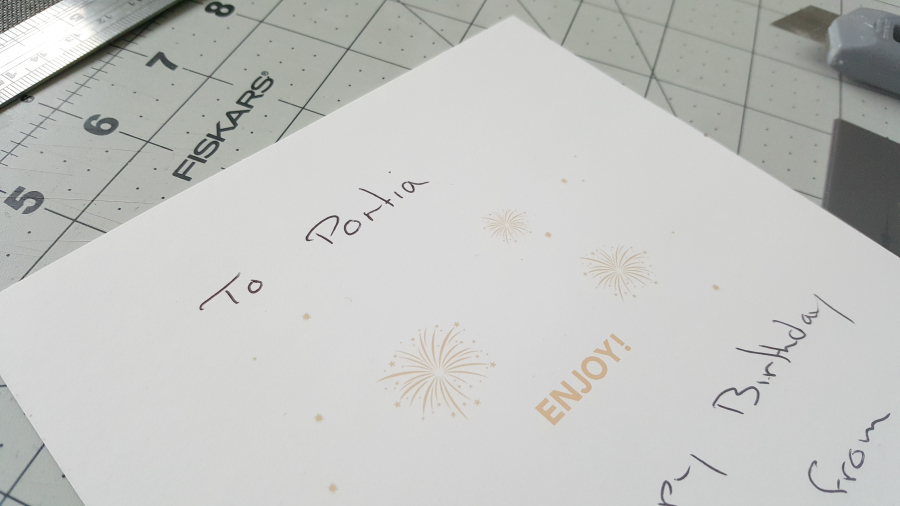
Really simple. Stanley knife, metal ruler, cutting mat and hole punch. I guess the trick is visualising where to cut and what would make a good “stand alone” image. I could definitely see the potential in this birthday card…RECYCLED GIFT TAGS


Start by seperating the front section from the back….RECYCLED GIFT TAGS


Having said that, don’t rule out the back piece entirely! That “enjoy part” would make a good tag right? Just check with every potential tag you are going to cut from your card, that the back is plain and clear for writing on…RECYCLED GIFT TAGS


Use the lines on your cutting mat to make sure everything is lined up and square and get cutting…RECYCLED GIFT TAGS


Once you’ve cut your tags, punch a hole ready for some ribbon or string et voila! Lovely card finds new purpose as lovely gift tags! RECYCLED GIFT TAGS


I probably won’t have to buy another gift tag all year tbh. I have a whole stack cut from birthday and Christmas cards. Here’s a few more examples (I did a load more after these pics were taken too. It’s kind of addictive!)RECYCLED GIFT TAGSRECYCLED GIFT TAGSRECYCLED GIFT TAGSRECYCLED GIFT TAGSRECYCLED GIFT TAGS


As a side note that I thought you’d enjoy, my Christmas gift tags this year were also recycled; but in a slightly different way. I took a bit of a shine to the packaging of a curtain pole we ordered for the new house (we bought a house in August). Black on one side. White and perfect for writing on on the other. So I naturally sliced it up into loads and loads of narrow rectangles…RECYCLED GIFT TAGS

The addition of a punched hole and some glitter duck tape and decorative washi tape transformed them into luxurious and glam gift tags. What’s more, this part is great for getting the kiddos involved with. Elliott had fun decorating these with random bits of tape and was super proud to see his tags on the pile of presents under the tree 🙂RECYCLED GIFT TAGS

So yeah. Anyone who sent me a card this year may well end up having it gifted back to them in the form  of a gift tag on a present. (Wonder if they’ll notice!). But much better than throwing those lovely Christmas and birthday cards away right?

Happy New Year to you all!

DIY, Uncategorized

Makers for Grenfell: Raffle Winners Announced…!!!

08/06/17

Makers for Grenfell - Raffle WinnersVery quick post from me this morning as we are busy here packing to move house. (Did I mention we’re on the move?)

But, before I get cracking on that, we have the small matter of announcing the winners of the 31 amazing prizes (!) on offer in the Makers for Grenfell raffle. Over 700 tickets (!) were sold raising over £3.5k with the total raised having now surpassed our target of £5k.  The JustGiving page will remain open for donations until the end of August as will the Instagram destash account. (So if you have stuff to sell in aid of Makers for Grenfell, hurry, hurry , hurry!)

But without further ado here are the winning tickets (yep we did a proper draw and everything!):Makers for Grenfell - Raffle Winners

If you see your name in there, head over to the prize post, pick one (or two if you’re one of the lucky ones that had 2 tickets pulled out!) then email me as quick as you can on portia@portialawrie.co.uk to let me know which one you want!  Prizes will  be allocated (ie winners will get to choose) on a first come, first serve basis. If after 7 days, no contact has been received, then another ticket will be drawn until all prizes have been allocated.

Thank you to everyone that supported the raffle. From providing prizes, to spreading the word, to buying tickets. What a community we have 🙂

I’ll be winding the fundraising up at the end of this month. Until then, here are a few ways we could add to our total:

makers4grenfell

Most of us have a few things in our stash that we will never use. So I have set up an Instagram account where anyone can go & post photos of their unwanted sewing/knitting/ craft related or handmade items. You then simply state how much you would like the “buyer” to donate to “purchase” the item. They donate directly to the dedicated Just Giving Page and you sort out postage etc between you. If you want to get involved and sell your unwanted stash, then DM me over on Instagram, either to @portialawrie or @makersforgrenfell and I’ll give you the login deets! But be quick as I will be closing this account at the end of the month.

makers4grenfell

Of course if you have nothing to sell but are in the market to buy sewing goodies, then make sure to follow @makersforgrenfell to stay up to date with new items being loaded. But be quick as items sell very quickly. So would recommend turning on post notifications for @makersforgrenfell on IG so you get notified as soon as someone posts. The goodies have not been hanging around for long. When you view the site, it may look full….but that is because posts will eventually get deleted once the transaction is complete. So don’t be fooled if you only see a handful of items 😉

makers4grenfell

Organise a craft jumble, a stitch and bitch coffee morning, a fabric swap, a raffle of your own, an auction. There are all manner of fundraising possibilities that you can organise independently, either online or in your local area and donate the proceeds to Makers for Grenfell. If you want to let me know about an event then email me at portia@portialawrie.co.uk  or tag me in social media and I’ll do my best to help you spread the word

makers4grenfell

A couple of businesses have already designated a “Makers for Grenfell Day” where a percentage of all sales on that day has been donated to Makers for Grenfell. It needn’t be all sales. Maybe sales of a particular type of product would be a better fit. And please don’t worry that it may be viewed as opportunistic self promotion. I know some businesses worry about this. At the end of the day it’s a good cause. That’s really all that matters. If you want to let me know about an “Makers for Grenfell Day” or something else you have planned. then email me at portia@portialawrie.co.uk  or tag me in social media and I’ll do my best to help you spread the word.

Massive thanks and well done you lot! Will keep you posted as to where the final amount will be donated to.

Older Posts
Portia
Follow
Sewbox

© Copyright 2026. Portia Lawrie. All Rights Reserved. Managed by WordPress Web Dev Cornwall .