• About
    • Contact
    • Press
    • Sponsor
  • DIY
    • Home & Garden
    • Jewellery & Accessories
    • Yarn Crafts
  • Sewing
    • patternless & self drafted
    • Refashions
    • Commercial Patterns
    • Sewing Tips
    • Overlockers
  • The Refashioners

Portia Lawrie

DIY, Fitting, sway back adjustment, Tutorials

Fitting: Sway back on a Colette Laurel (Pt II)

02/17/16

So a little latter than planned,, here’s the second instalment of the sway back adjustment I promised. You can read part one here. But just to recap quickly on where we got to…loadsa fabric in the back for me. Pinned one horizontal tuck….didn’t quite take care of it*. Pinned a second horizontal tuck further down…part one of problem solved… *(worth noting that I have omitted the back darts. This will have had a small impact on how much I had to pin out)colette laurel sway back adjustment

Then with the toile taken apart and pressed flat, I’d marked all my adjustment lines in pen and evened them all out…colette laurel sway back adjustment

Soooo…moving forward, the next step was to make those adjustments to a paper pattern. To do this I laid out my toile back piece and laid some swedish tracing paper on the top. Making sure everything was flat and weighted down…colette laurel sway back adjustment

Then traced off my pattern piece including all the markings where I want to remove the excess fabric in the back…colette laurel sway back adjustment

If you consider those markings as a dart , (essentially it’s the same structure) You could just treat those lines as dart markings and fold out the excess.  I’m using a slash and overlap technique here. Slice along the top dart leg. (Apologies for the poor lighting in these pics. Twas a very grey day indeed!) I should technically have left a little pivot/hinge at the narrow end. But I just sliced right through because I find the hinge thing fiddly. colette laurel sway back adjustment

Then overlap the pieces so that the bottom dart leg lies on top of the cut edge (or what was the top dart leg)…colette laurel sway back adjustmentcolette laurel sway back adjustment

Stick in place with masking tape and in my case, repeat for the second tuck. It’s at this stage when lined up against the straight edge of a ruler to mimic a straight CB seam, that you can see exactly the effect it is having. THAT my friends, is how curved my back is!! Crazy!! I actually held that up side on against the profile of my back and it totally is!colette laurel sway back adjustment

So. Hopefully up to this point this is all making sense. But here, for me is where I slightly depart from fully understanding the “why” of each stage and just start trusting that this works. Even though the next couple of steps, to varying degrees, may seem a little counter intuitive.

So I have my altered pattern. Now it’s so skewed that I need to “true” up various points to make it a useable pattern piece. I’ve stuck my pattern piece to my worktop with super wide masking tape, along the CB seam here. It stops it shifting around and gives me something to draw my new lines on. So firstly I want to square down from the neckline to the hem to give me a straight CB seam again. So here’s the counter intuitive bit right? I just curved that back seam. Why do I want to make it straight again? Well, my logic is telling me that the aim is not to curve the CB to echo the curve of your back but to shorten the CB and remove excess fabric. (The curve in the pattern above is a bi product of that rather than the actual aim) You still need a straight CB. You may also remember that after I’d taken the tucks out of my toile, the back became tighter. This step also adds some width back in at the CB to combat that….colette laurel sway back adjustment

The red dotted line is the outline of the  altered pattern piece. The straight solid pencil line is my new CB seam. You can see that it’s incrementally adding width back in down the length of the CB. I would imagine, relative to what we’ve taken out, but, in a different place. I’m beginning to understand this adjustment as a “redistribution” of the fabric to some degree if that makes sense? But please chime in if you can explain with more clarity!!

Below is the hem and CB seam.  Again, we need to square across from the side seam to the new CB seam. You can see the red dotted line shows how much the adjustment has skewed the hem. So by doing this, you can see we’re adding length back at the bottom of the CB seam (ie at the hem). This is the bit that seems the most counter intuitive. If we want to shorten the CB seam to counter the sway back issue, why are we lengthening it again? Again, my reasoning is telling me that we are redistributing that excess length that we took out. Moving it from where it’s not needed to somewhere else. But interestingly, when I measured it…it doesn’t add up to the total length of the tucks that I took out. And when I compare the length of the new CB to the one on the original pattern piece…it IS shorter by about an inch…despite the fact that it doesn’t look that way once the toile is reassembled with the new back piece! Weird right??colette laurel sway back adjustment

The final step is to redraw the side seam. With the original laid on top and matching the underarm and hem points, you can see how the adjustment has altered the shape of the side seam too.colette laurel sway back adjustment

Simply trace along the edge of the original pattern piece to get the side seam shaping back to what it should be. You can see that this will be removing overall width. So again, my reasoning is telling me that what we added in width when we squared the CB seam was more than what was necessary to bring the pattern piece back to it’s original proportions. So shaping at this side seam and removing a small amount of width in the process, is in theory bringing everything back into proportion in relation to the original pattern. I am not stating this as fact. This is me thinking out loud & trying to get my head around how this adjustment works. I know that it does work. But the geek in me needs to know why and how too!colette laurel sway back adjustment

With the new side seam drawn you can now see what will be removed from the side seams…colette laurel sway back adjustment

Now this is not a great picture (below) and if you’re viewing it on a mobile device you may not be able to see the detail. So take a look on a desktop if you get the chance…colette laurel sway back adjustment

My new pattern piece (above) with all the adjustments complete but before I cut it out. You can see the curved red dotted line at the CB and hem and the cut edge at the side seam. That’s the outline of the skewed pattern piece once I took those tucks out. The solid pencil lines are the new outline once I’ve done all the “trueing” and reshaping. You can see that a big chunk of width was added in at the CB when it was squared down, (look at the distance between the red dotted line and the new CB line) but some of that has been taken out again at the side seam when I reshaped it. (Look at the distance between the edge of the pattern and the newly drawn side seam).

Now, here’s the interesting part if you like a geek out! It may hold some clues as to why this works! With my new pattern piece all cut out, I laid it over the piece from the original toile. Although at first glance the piece appears to be the same shape as the original….look what happens when I line it up at the shoulders and armholes!!colette laurel sway back adjustment

Then look what happens when I line up the side seams…colette laurel sway back adjustment

WEIRD right??? The angles are totally different in relation to the original! Now, while I will not pretend I can thoroughly explain why this works, comparing those two pattern pieces and reasoning out what we’ve done, I’m forming a blurry idea of what’s going on in the big sway back mystery. It seems to me that the process is a combination of redistributing length (and consequently width) away from where it is not needed, and moving it somewhere else; and overall, reorientating the pattern piece.

Having said that I still don’t fully understand the why and how (mostly in relation to choosing where to square off from and to and why we add length back in at the hem); but I can prove to you that it IS what you do and it DOES work, because, well, look! I did it….and it worked!colette laurel sway back adjustment

I may revisit this on scale paper cut outs in an effort to understand it fully. Because it seriously bugs me that, although I know it works….that’s not enough! I need to know how and why. And this time I am going to make copious amounts of measurements and get all mathematical on it’s ass. If I have a eureka moment, rest assured I shall share because I know there are other geeks out there for whom “yes….but WHY?” is as common a question as it is for me. But for now, this is how you do a sway back adjustment!

A really good tute here just in case my pics don’t fully give you the full idea, btw 🙂


And in the meantime, if you have the ability to clearly explain what is going on with a sway back adjustment and why it works, or if you know of a blog post somewhere that clearly explains, not the how….but the why, then pleeeease tell! I’ve searched and searched the interwebs to no avail. Lot’s of “how to’s” out there. And I’m all like, “yes, yes , yes…but WHY do we square up here and not there and WHY do we add back length to the CB if we’re trying to shorten it???”

Yes, I am the adult version of that annoying child that repeatedly says “yes Mummy…but whyyyyyy?” until mummy screams and as a mental breakdown. 😉

Fitting, pattern adjustments, Uncategorized

Fitting: Sway back on a Colette Laurel (Pt I)

02/09/16

In many ways this post is kinda redundant from my perspective. Even as I type, this project has been shelved.  Again.  I bought the Colette Laurel as soon as it was released. Which was what? Like 3 years ago?? At that point I made two toiles. When I cut the  recommended size 12. It was huuuuge! So I regrouped and cut an 8. (I am NEVER an 8! Not complaining!) Then ended up grading down even further at the hips because the hip shaping on me (I have a very low hip/waist ratio),  looked like comical jodphurs.  I also had to lower the bust dart by 3 cm . That is where my boredom kicked in and my patience ran out 3 years ago and my Laurel was shelved for the first time…colette laurel sway back adjustment

Fast forward 3 years and I felt I’d forgiven this pattern enough to give it another try. I knew from last time that there were still some fit issues to fix. So I armed myself with an old kingsize duvet cover, anticipating, and prepared to make, multiple toiles. (I do question how bizarre my proportions must be to require such gritty determination!) My toile count is now at 5 for this pattern, and I’ve decided enough is enough. I really shouldn’t have to work this hard to get a simple shift dress to hang right. End of. So I have conceded defeat and concluded that this pattern and me….we just don’t work. Which is a shame.

BUT, it is a good opportunity to show you a sway back adjustment! Every cloud and all that! I covered this adjustment a few years back over on my old blog. But when I made the migration from Blogger to WordPress  a few posts were lost. This being among them. So now seemed a good opportunity to revisit it. It’s quite long; and I’ve taken alot of photos along the way. So this will be split into 2 posts. This being Pt 1…not just because of the adjustment itself….but also because, although I know this adjustment works… I haven’t quite gotten my head around why. There’s elements of it that are quite counterintuitive; and I wanted to open up the discussion a bit and hear from you on the subject. I am NOT a fitting expert. I’m still learning; so help a girl out if you have some insight here 🙂

For anyone that doesn’t yet know what a sway back  is,  (or indeed whether you have one ) it’s an above average (whatever that is!) inward curve in the spine. An arched back basically. If you have a sway back you may have noticed that alot of RTW clothes (and sewing patterns) will sit as they do in the left hand picture below. That is, an excess of fabric “pooling” or bunching in the lower back. This is because that “curve” in your back is essentially shortening the distance between your shoulders and your backside. Basically meaning that the CB on a sewing pattern will be longer than you need it. (It’s worth noting that there are other fit issues that can cause this effect in back ((such as being too snug at the hips )). But because these horizontal wrinkles stop at the side seams, and my side seams are hanging freely, I know the problem is in the back. Savvy?) If that bunchy fabric at the back bugs you, then a sway back adjustment takes care of that and allows the back to hang smooth. Like the picture on the right! colette laurel sway back adjustment

It does this by means of removing horizontal tucks/wedges from the CB and redistributing them, among other places, at the hem.  Usually it’s only a small amount.  My back curve it seems…is quite extreme.  I began by taking out that tuck at the top of my lower back; and when it didn’t quite fix the issue, I took that second tuck out at my lower back. From what I’ve seen this is relatively unusual. Usually it’s just the one tuck, and much smaller at that. It may be related to the fact that my upper back/shoulders are rounded which will also have an effect on the way the CB hangs on me; and it’s worth noting here that I have an 8″ long  2″ wide dart basted out at the CB neck to fix that. But in any case…I’ve always been taught that it’s a case of interpreting what the fabric is telling you when it comes to pattern adjustments…and you can see that the double tucks have removed that pooling fabric and allowed the CB to hang straight.colette laurel sway back adjustment

You can also see in the far right pic above that the back is overall, tighter than it was. That’s fine because when I make the adjustment to the pattern I’ll be redistributing that fullness elsewhere which will take care of that. Soooo…

colette laurel sway back adjustment

Above is what the back looks like from the right side with those tucks taken out. Turns out that squared fabric was quite useful in that it really highlights how that tuck is re-orientating the back. Notice that the CB is still straight.

Below you can see the effect it has on the hem. I’ve basically pulled up that hem at the centre by pinching out that length further up. This gets fixed on the paper pattern later…colette laurel sway back adjustment


colette laurel sway back adjustment

So here it is inside out and you can see those tucks in all their glory. Essentially it’s a French dart turned on it’s side.  I stitched them during the fitting process so I could get a better idea of  how the final adjustment would look. Plus it’s flippin’ hard to fit the back on your own. With pins. Ouch! I took a chalk pencil and drew over all my stitching lines and also marked the fold of each tuck at the CB.colette laurel sway back adjustment

Once I seam ripped all my basting and pressed it flat this is what the back piece looked like. You can see the tucks (AKA what I need to remove) clearly marked. Widest at the CB and tapering to nothing at the side seams.colette laurel sway back adjustment

Here’s the CB. If you think of this as a dart just for a moment, I’ve now got the centre point marked, and the dart legs either side of it…colette laurel sway back adjustment

I separated my toile at the CB and took one half to use as my new pattern. (You can see the massive dart I had to take out of the neckline too.) Then using all those points I’d marked I smoothed out my lines with a ruler, drawing directly onto my fabric, and making sure that the centre line of those tuck was square to the CB line. Make sense?colette laurel sway back adjustment

Here’s a close up….colette laurel sway back adjustment

So from here, the next step is to transfer those marks to, and make the adjustment on, the paper pattern. Then of course…test it with a second toile. That post will be up later this week. But in the meantime….if you have any insight into a sway back adjustment, have anything to add, tips for improvement etc (or if you just want to rant about fit issues and how annoying they are!) please feel free to chime in!

Dressmaking, finished garments, Fitting, Giveaways, Sewing, simplicity 1918, trousers

Simplicity 1918 – Amazing Fit Trousers? (+ a GIVEAWAY!)

07/07/13

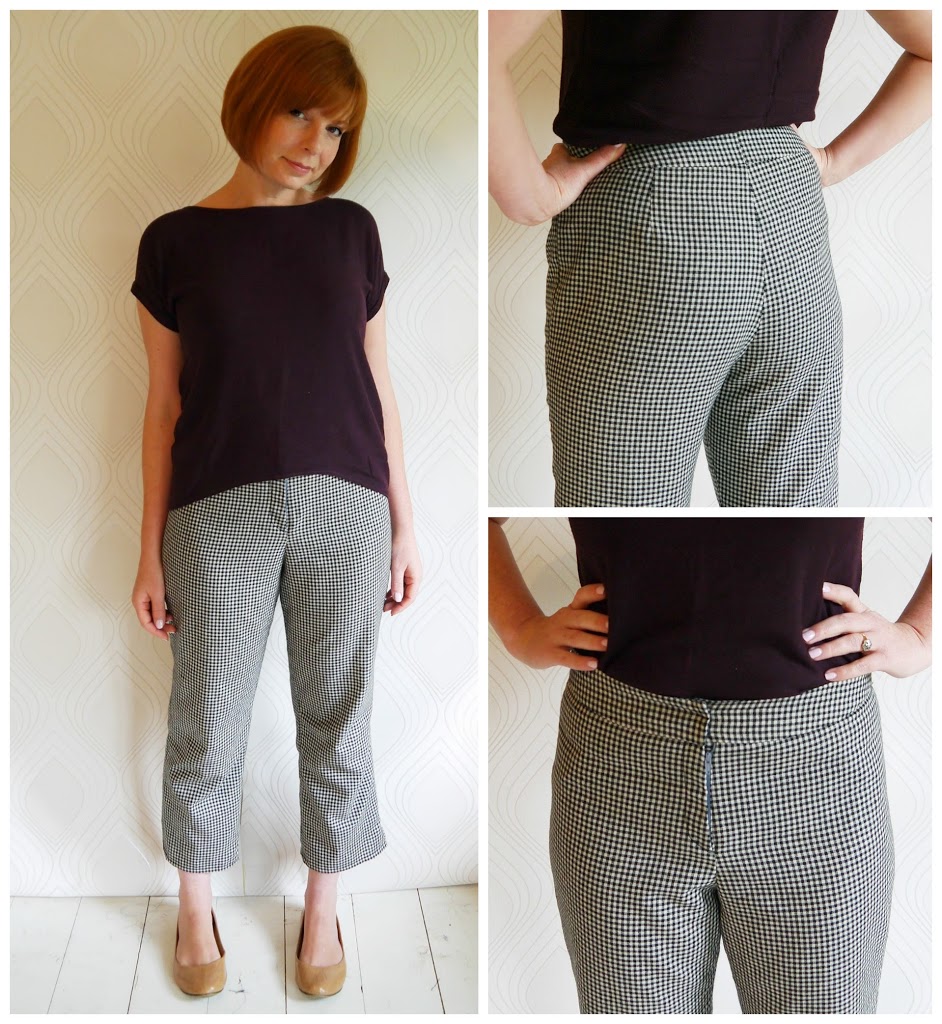
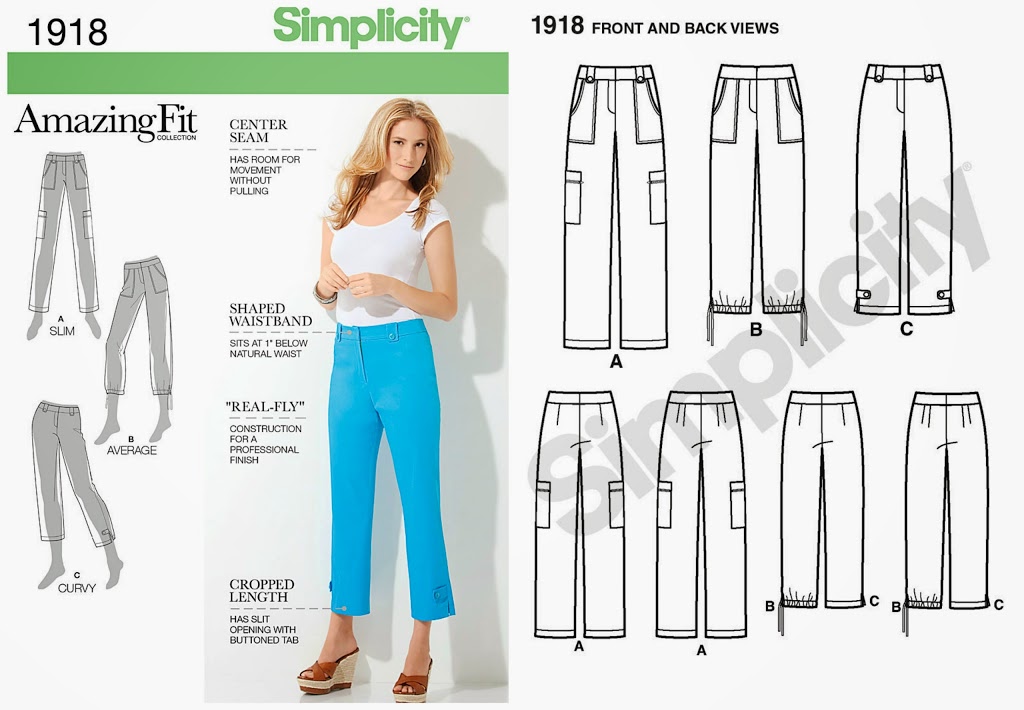
Sooooo…this post marks a bit of a dressmaking milestone for me. 🙂 My first ever pair of trousers. Simplicity 1918 – from their Amazing Fit range. (View C minus the tabs 😉 What say you peops? Are Simplicity right? Are these indeed an amazing fit? I must admit….I’m seriously impressed. This was actually meant to be a 1st toile. I never anticipated ending up with a pair of trousers I could actually wear with the first attempt. I pictured re-pinning, tracing, redrawing crotch curves. I was ready for a battle. But no. I cut the pattern (not quite according to the instructions, more on that in a bit). I sewed them up according to the instructions. I put them on; and apart from a teeny adjustment at the waist and hip (more on that in a bit); this is how they fit pretty much straight out of the packet….they’re made from a lightweight pure wool check bought for £1.60 at the craft jumble I mentioned previously…

Having read numerous horror stories about crotch length and rise and drag lines; I’d kind of built up trouser sewing in my head as a bit of a mountain that I wasn’t sure I wanted to climb. I mean any area of sewing that requires a plethora of books and classes aimed solely at achieving a good fit, has got to be head bangingly frustrating right? Well, that was the view I held at any rate.

When Simplicity asked me if I’d like to pick out a pattern to test out, I saw it as a great opportunity to slay the trouser beast. Especially when my eyes alighted on the words “Amazing Fit” and “Trousers” on the same pattern envelope. I thought it HAD to improve my chances of success. The schtick here, is that this range of patterns comes not only in a the usual range of sizes, but also in 3 separate figure types. Slim, average and curvy. Welcome acknowledgement at last from one of the big 4; that we do actually come in different shapes and sizes….amen to that!

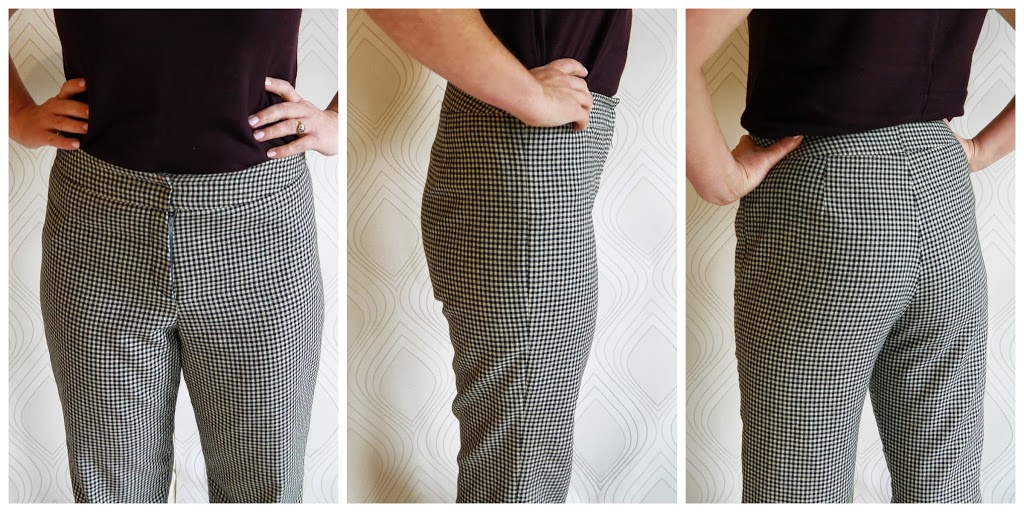
So…how good is the fit? Here they are from various angles. I’m no expert of course. But to my mind, there are no areas that are pulling, there are no areas that are bagging. Nothing is twisting, side seams are perpendicular to the floor and the fabric lays smooth across the front and backside; and I can move about, sit down and stand up with no strain on any seam and what’s more, they are VERY comfy. Is it me? Or is this a bit of a result for a first pass??!

A word or two on Sizing:
The only time that I deviated from the instructions was when it came to selecting which size to cut. According to my measurements, I should’ve cut a 16. Wasn’t convinced by that AT all. (Commercial patterns always seem to equate to excessive ease in my experience) Especially taking into account that the pattern cites 4 – 4 1/2″ of wearing ease included. I am a 40″ hip. Cutting a 16, according to the pattern envelope, would’ve given me a finished garment measurement of 44″ at the hip. A size 14″ however, would give me a finished garment measurement of 42″ at the hip. Better 🙂 That’s my hip measurement + 2″ of wearing ease. Plus, there’s a generous seam allowance (a full 1″) built into this pattern at the waist/hip seams and centre back seam to allow for adjustments. No worries then! So that’s what I went for. I cut a 14 “average” because my crotch length dictates that I am of average shape 😉 Once I’d  basted them together, the only adjustment I needed to make was to let the waist out by about 2-3mm each side, and shave the hip curve off because basically, I’m pretty much straight up and down and don’t need my trousers to curve out much at all at the hip. That’s it.

Next time:
The only changes I would make on future makes (and there will be some for sure) would be to narrow the bottom leg slightly (a teeny bit flappy) and sew a better fly front. This was also my first time ever sewing a fly front. It turned out ok but you can still see my zip a bit; which is not the idea methinks! But thanks to your suggestions on fly tutes; (Thankyou so much!) I’m confident I’ll do better next time!

Overall though, I’m totally impressed with this pattern; and it has me wondering if other patterns in this range are worth my attention. After all; how many times does a pattern fit you pretty much perfect, straight out of the packet?? For me, never, until this one!

Giveaway Conditions:
Sooooo, the lovely folks at Simplicity sent me 2 copies of this pattern. So that means I have one left to give away to one of you! The giveaway pattern is the very same pattern Simplicity 1918 in a size 14-22.

The giveaway is open Worldwide and all you have to do to enter is leave a comment below; tell me if you’ve ever found a pattern that fit you straight out of the packet, and what it is please?! If you’ve never been that lucky, then just tell me an interesting sewing or fitting tip or failing that; just something interesting! You don’t have to follow this blog or like my facebook page or any of that malarkey! Just don’t put “yes please” or anything like that cos well, that’s just boring 😉


Giveaway ends on Wednesday 17th July at midnight GMT and results will be announced on Thursday 18th July. Good Luck!

**NOW CLOSED**

cynthia rowley 2512, finished garments, Fitting, pattern adjustments

FO – Denim Cynthia Rowley 2512

10/15/12

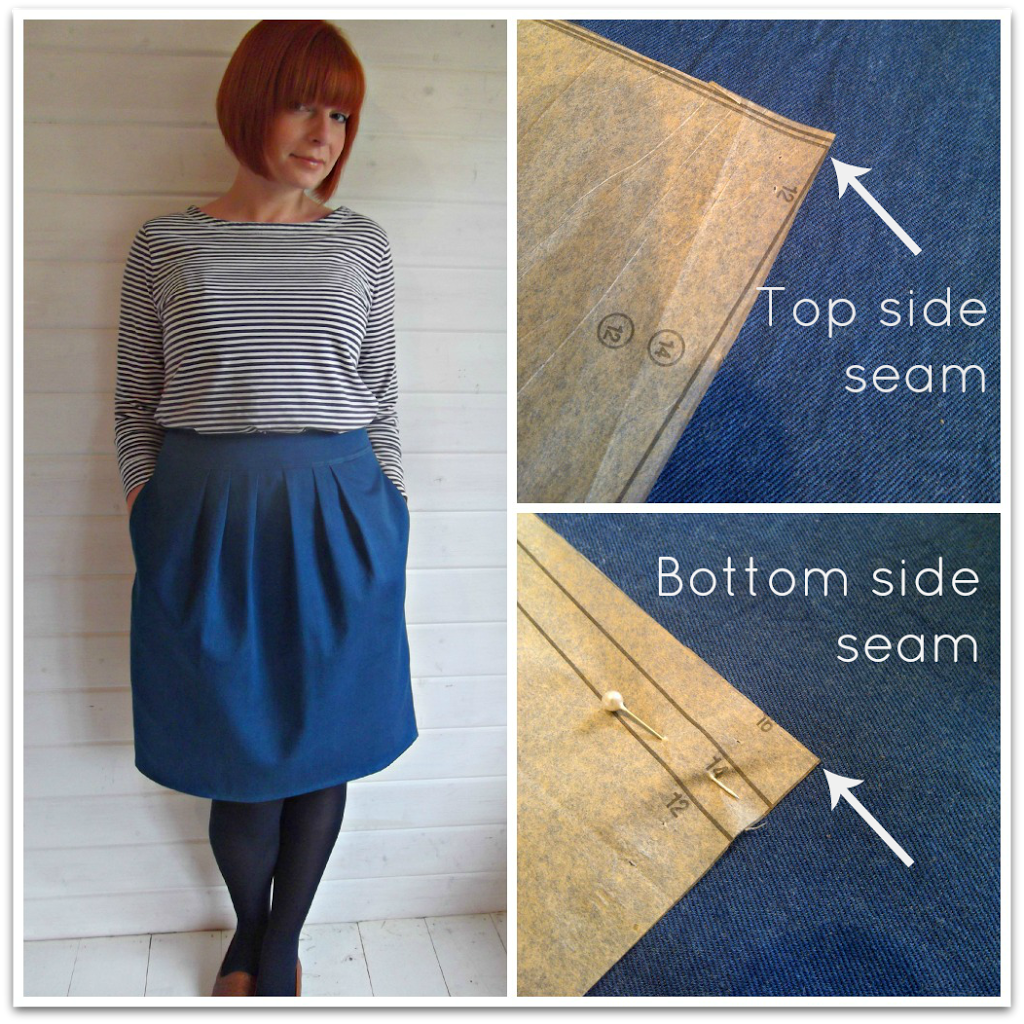
Further to my previous incarnation of this make, I thought I’d have another stab at it. I cut the previous one to a 14 at the waistband, and whilst it fit, it felt a little too generous. So I opted to cut this one at a 12 at the waistband. Apart from the size, there were a few tweaks that I wanted to make to this pattern. Whilst I liked the gathered element of this skirt, the “poofiness” around the abdomen and backside was a little too exaggerated for me to be entirely happy with it for everyday, practical wear. I wanted to tone it down a bit. So I tapered the side seams on both the front and back skirt pieces. Starting at a 16 at the hem and tapering to a 12 at the waist…

Anyone who has made this pattern will recognise the trapeze shape of the front skirt piece once it’s been cut out. All of that with along the top is converted to gathers (or pleats if you’re me!) and that translates to volume. Around the abdomen ladies! Not a place most of us want to add volume! At least not to the extremes of this pattern, and certainly not with my mummy tummy! Essentially, all I did was tone the angle down a bit. The red lines/arrows mark where I cut so you get an idea of what I removed from the original pattern.  You can see that this has the effect of removing width  at the waist; width that would otherwise have been gathered and translated into “poofiness”…..

I made this adjustment to both the front and back pattern pieces. So when all told, it added up to around 4″ of overall gathering removed from around the abdomen area. Which feels so much more flattering (and I’m told looks so too :). This new version still retains that “tulip” shape that originally drew me to the design, but in a much more subtle, and hopefully more flattering way.
On the downside, despite being prewashed and seeming really good; this denim actually creases like hell during proper wear. But I’m hoping a few more washes will soften it up some!
Overall though, pretty pleased 🙂
Have you tried this pattern and found it too “poofy” for your liking? Is “poofiness” even a word?!

Fitting, Pattern Drafting, Top Draftalong

Top Draftalong # 32 – Sway Back Part 2

12/09/11

This post has been in draft for some time. Seriously….weeks.  Day to day life and family matters have been pretty hectic to say the least. In any case, FINALLY I have a toile that I can turn into a block with which to begin drafting some designs! Hurrah!! That aspect of things I will now have to put on hold until the new year, due to Christmas gift sewing. I’m guessing though that anyone who may be following these posts will be in the same position, so it seems to me that starting the drafting process fresh in January is the best option. So this will be the last Draftalong post until the New Year.
When I last posted, I had adapted my pattern to take out a big tuck as part 1 of a sway back alteration, but had yet to test the results on my final toile. Well, here it is….(I’m not quite sure why I look like I’m striking a body builder pose on the right,btw! Heurgh!!))

See the difference?! Excess fabric gone and the additional ease at the side seams is alowing it to fall comfortably over my hips. The image on the left shows the excess fabric pinned out in a horizontal tuck in the small of my back on the original toile, and the very slight snugness on my hips.  The one on the right is the final toile, cut using the newly altered pattern . No more fabric pooling…….

and from the side……

Apart from the tuck itself, there were a couple of other elements to finalising my toile. In my previous post, I incorrectly assumed that I needn’t square off the hem after I had taken the tuck out of the pattern. I assumed the “distorted” hem was all part of the “optical illusion”  to correct the sway back. Hmmmm. Not so apparently. I did indeed need to square off the hem from the CB to the side seam. You can see the distorting effect of the tuck on the hem in the left hand picture; and the “wedge” added on below the dotted line in the right hand picture….

In addition, I added a CB seam to this toile on the advice of my tutor. “Just in case” further alterations were needed. Good job too, because the tuck on it’s own wasn’t quite sufficient. In order to get the back to sit just right,  I ended up taking out a tapered vertical “tuck” along the CB seam of the toile,to remove the last bit of excess fabric. It tapers to nothing at the neckline, with it’s widest point at the hem. Essentially, taking in the CB seam at an angle. Were I being truly conscientious or aiming for a totally accurate fitted toile, then the new CB seam would be curved inward at the small of my back. But I was happy to keep it simple and opted for a straight tapered CB seam as opposed to a curved one.

The overall shape of this toile is exactly what I’d envisaged as a basis for future designs. I will never want to make a top more fitted than this. It just wouldn’t suit my shape. So for me, a simple, semi fitted, boxy shape that I can add some design details to, and manipulate shape wise, is just perfect.

One final tweak I’ll make is to lengthen the bust darts. I shortened them a bit tooooo much on this toile, trying to avoid the pointy bust look. But where they are now, they’re not providing quite the right amount of fullness. (Ohhhhh, NIPPLES to it!) I’m pretty sure just lengthening them will sort out any remaining drag lines on the bust….

Sooo, here is my block. Traced onto card from my final pattern. Without seam allowances. Ready to start playing with designs in the New Year. Here’s a round up of the main adjustments I’ve made to my toile to get it to this point:

  • Assessing the initial fit issues
  • Moved the bust dart
  • Enlarging the bust dart Pt 1
  • Enlarging the bust dart Pt 2 
  • Sway Back Adjustment Part 1
  • and finally this post….

I’ve been sketching out some ideas as well as perusing the ones in the book that got me started on this draftalong in the first place. (Epic journey that it has become! 32 posts so far! What planet was I on, thinking I could have this done and dusted withing a few weeks??!)
I fancy starting off with experimenting with collars (Peter Pan, Sailor?) and maybe some pintucks, pleats, gathers etc. How about you? What design details would you try first if you were drafting a pattern to your own design?
Px

Fitting, Pattern Drafting, Top Draftalong

Top Draftalong # 29 – Bust Dart Enlargement

08/25/11

Ok so here goes. This is a LONG post peops. I racked my brains trying to seperate this into more bitesize individual posts but each stage of this is so interlinked with the next that I decided to just keep it all together in one place. Recommend sorting yourself out a glass of wine/coffee/tea/beer (delete as appropriate) and put your feet up. Ready?
Okey dokey. Firstly I should mention that I have decided to ditch the block pattern from the book. (Eeeep! Yes the one that I’ve spent all that time on!) in favour of the Sorbetto from Colette patterns. The issue I’m addressing in this post was exactly the same on both patterns, but the Sorbetto just seems to suit me better overall and I just think for me it would make a better block/sloper pattern in the long run. You may recall the stage I was at here.  I had pinned out some excess fabric at the armhole and needed to transfer those markings on the toile to the paper pattern so that I could rotate this unsightly dart in the armhole and add it into the bust dart instead…(the first few photos were taken at night so apologies for the poor lighting)

Here’s my toile (I used no sew interfacing to make it. Top tip. It works brilliantly!) with the armhole dart marked out where I’d had it pinned…

I layed my tissue pattern on top…

and traced the armhole dart onto it…here’s the toile and the tissue pattern side by side…

I then extended a line through the centre of each dart until they crossed….

I cut along the lines at the centre of each dart, stopping just short of the crossover point to creat a hinge/pivot point…

I closed off the armhole dart by lining up the bottom dart leg on top of the top dart leg. This results in the bust dart enlarging by the exact same amount….

I then secured with masking tape (easier to reposition than sellotape and you can iron and draw over it too. Win win win!) I called it a night at this point and spent the night tossing and turning and muttering about armholes and bust darts in my sleep…apparently!

Next day (!) I secured a slip of paper with masking tape on the underside of the new dart…

This was a tricky one to do (and photograph) but I eventually managed to fold out the dart with the side seams above and below the dart lined up as they would be if I were constructing the dart on the garment (they are lined up honestly! It’s the camera angle in this photo that makes it look wonky)…

Then cut along the side seam…

and open the dart out again…ta dah!! New “boobalicious” bust dart…

Of course, now the armhole is all wonky! Closing up the armhole dart has raised the bottom of the armhole too high and at a funny angle. Place a piece of paper behind the armhole and tape in place as before…

I held the pattern piece against myself to get a rough idea of where the new armhole curve should start on the side seam and marked it on the pattern. Back on the cutting table I drew in the new armhole shape starting at the point I had marked on the side seam,(make sure the first 2-3mm of the armscye is at a right angle to the side seam or you’ll get a “peak” when the side seams are sewn together) drawing a smooth curve and blending it into the upper part of the armhole curve. You can use a French curve (visible in picture) but in the end I printed off a copy of the front armhole section of the original PDF pattern and used this as a template to get the curve just right

A quick snip later…armhole curve sorted. That looks better! 

Here’s my new pattern piece. Unsightly armhole dart rotated into bust dart and the armhole curve reshaped. So we’re done right?

Nope! One final adjustment. This is the original pattern lined up at the armhole. See how the front piece is marginally longer than the back? Well this is where my pattern cutting classes kicked in. Somewhere in the deep dark recesses of my befuddled brain, I remembered….

The width of the dart…

Is directly proportional to the “extra” length at the hem of the front pattern piece…because of course, when the dart is closed, this extra length is taken up…

Applying the same principle to my newly adjusted pattern….
I measured the width of the new dart…

and worked out how much extra to add to the hem to compensate for the extra length that would be taken up by the wider dart…(does this make any sense??)

So here is my new pattern….

I’m happy to report that everything lined up perfectly when I made my toile (that post to follow) so I was super chuffed with myself and this process has marked a bit of a Eureka moment for me. Both in fitting and the pattern manipulation process. It’s a case in point that “every action has an equal and opposite reaction”.  Each alteration will impact on another part of the pattern and generally require a compensatory alteration elsewhere to get everything to line up again. It’s this emerging awareness of the “bigger picture” that feeds the slight addiction I have to pattern drafting. It’s a bit of a love hate relationship because it has me swearing and tearing my hair out as much as it has  me jumping for joy at a new principle understood!

I tell you what though…I never thought I’d be referencing Newton and Archimedes to in a blog post about how to make a top that fits me!! Hilarious! Hmmm. Professor P…has a nice ring to it…;)
Px

Fitting, Pattern Drafting, Top Draftalong

Top Draftalong # 28 – Bust Adjustments

08/24/11

Ahhh, finally! I am soooooo sorry if I’ve kept anyone waiting with these posts. But I have managed to squeeze some time out of the last few days to make some progress on the Top Draftalong. I have lot’s to share with you, but first things first. This is the last of the “mini posts” detailing the fitting issues covered in the book. Bust Adjustments. (Bleurgh!!) As luck would have it though,  there are a number of decent tutorials out there to reference for this particular area of fitting.; a roundup of which can be found at the end of this post.  Here’s what the book has to say on the subject of bust adjustments:

“With a larger than average bustline, your toile will appear very stretched across the bust and the darts will not be providing enough fullness. Mark your bust point with a dot on the toile then transfer this position to the paper pattern. Draw a line through the centre of the dart to the bust point. Draw another line beginning at the middle of the shoulder, down through the bust point to the hem, passing through the middle point of the waist. Cut through the dart, leaving a 3mm hinge at the bust point, then cut from the shoulder to the hem, leaving a hinge at each end. Place a piece of paper underneath the pattern, then spread out the vertical opening by the required amount at the bust point. The dart will automatically be enlarged. Pin in place and then reshape the side seam. (diagram far right of image)”

“A smaller than average bust forms folds of excess fabric over the bust which must be dispensed with. draw the lines and cut your pattern as before, but this time overlap the vertical opening at the bust point to remove the excess fabric. This of course, decreases the bust dart. Reshape the side seam”

Gertie has a roundup of great tutorials here. There’s an example of the FBA  in action here and here and a well illustrated example of the SBA here (in fact the first stages are applicable to the FBA too).
Px

Portia
Follow
Sewbox

© Copyright 2026. Portia Lawrie. All Rights Reserved. Managed by WordPress Web Dev Cornwall .