• About
    • Contact
    • Press
    • Sponsor
  • DIY
    • Home & Garden
    • Jewellery & Accessories
    • Yarn Crafts
  • Sewing
    • patternless & self drafted
    • Refashions
    • Commercial Patterns
    • Sewing Tips
    • Overlockers
  • The Refashioners

Portia Lawrie

DIY, how to, pattern adjustments, Pattern Drafting, Sewing, Tutorials, Uncategorized

The Copycat Crepe Top – (Part 3) – Grading the sewing pattern down (or up!) a size

02/28/16

Ok, so following on from Part 1 & Part 2 of The Copycat Crepe top my final step was to take the pattern that I had copied from the original RTW garment and size it down. This is a first for me. I had never graded a pattern before. But thanks to this great tutorial from Melly Sews (There was also one from Burda that I now can’t find, aaaargh!) I was able to figure it out. I thoroughly recommend hopping over to that tute as well, if this is something you are planning to try!

So here is where I was at….MAKING A SEWING PATTERN FROM AN EXISTING GARMENT

MAKING A SEWING PATTERN FROM AN EXISTING GARMENTI had made my pattern and tested it with a toile; and in every way in terms of how it hung/fit on me it was pretty much identical to the original top. So I was feeling pretty chuffed with myself! (First time I had made a pattern from a rtw garment too!). Including the fact that it was too big. Probably by about 1-2 sizes was my best guess. The label had been removed so I don’t know the original size.  Based on how the top fit me I reasoned that the difference between the bust size of the top and my own bust size, was about 3″.  That is therefore, how much I wanted to reduce the pattern by across both the front and back pattern pieces. (Known as the “total grade”).

All the advice out there btw, asserts that 1-2 sizes (around 2″) is about the maximum you want to grade a pattern up or down by, in one pass. The reason being that the pattern begins to get increasingly distorted the more you grade by. If you want to grade a pattern by substantially more than that, then it’s best to do it in stages. Grade by 2″ make a totally new pattern, then grade that one by 2″. Obviously I haven’t done that. I’ve graded by 3″. Because I’m naughty like that.

This method involves slashing the pattern pieces along various lines, and overlapping them. Thus making the pieces incrementally smaller. (The exact same process applies for making it bigger, except you spread instead of overlap) The total grade amount (3″ in my case) is split up evenly between the front and back pattern pieces, and then again between multiple lines on those pattern pieces. So each individual overlap is relatively small, but added together they all add up to 3″. (The sleeve is addressed separately after grading the main pattern pieces).

Right, so seeing as this requires me to slice up my pattern pieces, the last thing I wanted to do was mess up the pattern I had so painstakingly created. So my first step was to trace off copies of all the pattern pieces….(then if I fluffed this I was still ok!)GRADING A SEWING PATTERN DOWN - OR UP - A SIZE

Next I drew in my “slash” lines. The process is the same for the front and back pattern pieces here. It’s a simple dartless top so nothing to complicate things thank goodness. You can see 3 vertical lines here. (Yep, they’re double lines but I’ll get to that in a moment. For now lets just call it 3 places on the pattern where I’ve drawn vertical lines, lol!). And one horizontal line. All of the vertical lines are parallel with the CB/CF lines . The horizontal line is perpendicular (90 degrees) to the CB/CF line….GRADING A SEWING PATTERN DOWN - OR UP - A SIZE

Line 1: straight down from the neckline. Line 2: Straight down from the shoulder. Line 3: straight down from the armhole.  Reasonably, when you consider a multi size pattern, then the neckline, shoulder and armhole will differ proportionately between sizes in those areas. So it makes sense to put the adjustment/slash lines in those positions. The horizontal line is roughly at the waist. A pattern will not change in length between sizes, as much as it does in width. So the adjustment here is small, and it seems from everything I’ve read, a standard 3/8″ between sizes. **(see note further down. I did end up putting a second horizontal slash line across the armscye. It may even be preferable to add a third horizontal slash at the shoulder and spread your 3/8″ between them)

OK. So a little math before we go any further. My total grade (the total amount I want to reduce the garment by) is 3″. I’m going to switch to cm here as it gets a little tricky to show the math in inches! So 3″  converts to roughly 7.6cm

I want to split that between two areas. The front & back of the garment. 7.6cm divided by 2 = 3.8cm. So I want to remove 3.8cm from the back of the garment, and 3.8cm from the front.

My pattern pieces represent half the back of the garment and half the front of the garment. So I need to split that measurement in half again. 3.8cm divided by 2 = 1.9cm.  So I want to remove 1.9cm from the back pattern piece, and 1.9cm from the front pattern piece. For the sake of simplicity, what’s 1mm between friends (at least on a loose fitting garment like this)? I’m going to call that 2cm. Just because that’s easier to work with without me losing the will to live!

So now I want to take that 2cm and divide it between my 3 vertical lines.  But hold your horses! It seems that it’s not quite as straightforward as dividing it by 3.  It’s never THAT simple, lol! But…it does make sense. From what I gather from the reading I have done, the change between sizes doesn’t happen equally in those 3 areas. (The vertical line’s I’ve drawn will directly affect the neckline, shoulder and armhole width). The greatest proportion of the change between sizes happens nearest the side seams and that vertical line at the armhole. With a slightly smaller change to the neckline and shoulder….GRADING A SEWING PATTERN DOWN - OR UP - A SIZE

So, with that in mind I took 1cm from the slash line at the armhole. Then 0.5cm each from the slash lines at the shoulder and neckline…GRADING A SEWING PATTERN DOWN - OR UP - A SIZE

My lines here are double. The first line on the left is the one I plan to cut. The second line is drawn to show where I want to butt the cut edge up to when I overlap; the distance between those two lines is the amount I want to grade by in that section.

In the picture below I’ve marked my cutting lines with an x…and marked the distance between the two lines. Essentially I’ll be removing the sections between those two lines…GRADING A SEWING PATTERN DOWN - OR UP - A SIZE

The double dashed lines above are balance marks. They should be perpendicular to my slash lines and drawn with a ruler. I was being a bit slapdash there, sorry! The purpose of them is to provide alignment marks once the piece is slashed. What we don’t want to do is accidentally shift the pattern pieces up or down when we overlap/realign them as this will distort the pattern. Horizontal balance marks serve as a guide to line everything up again…

As does the horizontal slash line at the waist line…GRADING A SEWING PATTERN DOWN - OR UP - A SIZE

So with all of that in place I took a deep breath and sliced up my pattern along my 3 vertical cutting lines…GRADING A SEWING PATTERN DOWN - OR UP - A SIZE

Then overlapped the cut edge up to the second line that I had drawn and stuck in place. You can clearly see why hastily drawn angled balance marks don’t entirely work, lol! The must be straight and at 90 degrees to your vertical line to be effective. Luckily that horizontal line at the waistline served as a very effective balance mark and by aligning that, I made sure the pieces didn’t shift up or down as I overlapped them…GRADING A SEWING PATTERN DOWN - OR UP - A SIZE

On both the front and back pieces….I overlapped all 3 vertical slashes by the amount that I’d marked. (0.5cm  + 0.5cm  + 1cm  = 2cm.)  The horizontal line at the waist is overlapped by 3/8″. Again, from all my reading it seems that this is a standard in pattern grading. For each size you go down (or up) the length is reduced (or increased) by a standard 3/8″. **(I did go back and put a second horizontal slash line extending from the CB/CF line through the armscye and overlapped that by a further 1/8″.  I should probably have done this from the outset plus another horizontal line at the shoulder for good measure. Both those additional horizontal lines  serve to reduce the height of the armscye which seems to me a sensible thing to do as this is something that does change between sizes. As it is mine worked out fine. But…just sayin….).GRADING A SEWING PATTERN DOWN - OR UP - A SIZE

Overlapping will leave areas like the shoulder…GRADING A SEWING PATTERN DOWN - OR UP - A SIZE

The armscye…GRADING A SEWING PATTERN DOWN - OR UP - A SIZE

And the hem… GRADING A SEWING PATTERN DOWN - OR UP - A SIZE

…with areas that need smoothing out.

I tend to make a little “extension” in the area I want to redraw by sandwiching the paper pattern between two layers of masking tape…GRADING A SEWING PATTERN DOWN - OR UP - A SIZE

….and drawing my new line onto the masking tape. If you look carefully you can see the pattern through the masking tape in these pics…GRADING A SEWING PATTERN DOWN - OR UP - A SIZE

Then simply cut away the excces along the new line…GRADING A SEWING PATTERN DOWN - OR UP - A SIZE

Same on the neckline and shoulder and hem…GRADING A SEWING PATTERN DOWN - OR UP - A SIZE

GRADING A SEWING PATTERN DOWN - OR UP - A SIZE

When it comes to grading the sleeve pattern, it’s all about establishing the total amount that you have removed from both the front and back armholes, and removing the same amount from the sleeve pattern…GRADING A SEWING PATTERN DOWN - OR UP - A SIZE

Mine was 1cm from the vertical slash at the armhole on both the front and back pattern pieces. So 2cm in total. Then I took a further 1/8″ across a horizontal slash on both the front and back pattern pieces. So another 2/8″ there. Of course it’s just like me to mix up my metric and imperial as if things aren’t confusing enough, lol!!GRADING A SEWING PATTERN DOWN - OR UP - A SIZE

After a bit of conversion and rounding I calculated I wanted to remove a total of 1″ from the sleeve pattern piece so it matched what I had done to the armholes when I graded them.

The sleeve pattern I slashed with 3 vertical and 1 horizontal line. I spread that 1″ total grade as follows: 3/8″ at the left and right vertical lines. Then 1/8″ each at the centre vertical and 1/8″ at the horizontal line. (You can also see I drew my balance marks properly this time, lol!) Then smoothed out my lines as above….and I was done…GRADING A SEWING PATTERN DOWN - OR UP - A SIZE

I don’t think I did everything technically perfectly here. Namely the number of horizontal slash lines I started with. But hey…it all worked out…and it WORKED! So as my first attempt at grading…I’m pretty chuffed. And it’s nowhere near as difficult or scary as I thought. Being able to grade up or down a size opens up a whole host of options….THE COPYCAT CREPE TOP

…I’m intrigued to learn more!

Don’t forget the Copycat Crepe  Top giveaway with The Splendid Stitch here! Closes tomorrow!!!

Fitting, pattern adjustments, Uncategorized

Fitting: Sway back on a Colette Laurel (Pt I)

02/09/16

In many ways this post is kinda redundant from my perspective. Even as I type, this project has been shelved.  Again.  I bought the Colette Laurel as soon as it was released. Which was what? Like 3 years ago?? At that point I made two toiles. When I cut the  recommended size 12. It was huuuuge! So I regrouped and cut an 8. (I am NEVER an 8! Not complaining!) Then ended up grading down even further at the hips because the hip shaping on me (I have a very low hip/waist ratio),  looked like comical jodphurs.  I also had to lower the bust dart by 3 cm . That is where my boredom kicked in and my patience ran out 3 years ago and my Laurel was shelved for the first time…colette laurel sway back adjustment

Fast forward 3 years and I felt I’d forgiven this pattern enough to give it another try. I knew from last time that there were still some fit issues to fix. So I armed myself with an old kingsize duvet cover, anticipating, and prepared to make, multiple toiles. (I do question how bizarre my proportions must be to require such gritty determination!) My toile count is now at 5 for this pattern, and I’ve decided enough is enough. I really shouldn’t have to work this hard to get a simple shift dress to hang right. End of. So I have conceded defeat and concluded that this pattern and me….we just don’t work. Which is a shame.

BUT, it is a good opportunity to show you a sway back adjustment! Every cloud and all that! I covered this adjustment a few years back over on my old blog. But when I made the migration from Blogger to WordPress  a few posts were lost. This being among them. So now seemed a good opportunity to revisit it. It’s quite long; and I’ve taken alot of photos along the way. So this will be split into 2 posts. This being Pt 1…not just because of the adjustment itself….but also because, although I know this adjustment works… I haven’t quite gotten my head around why. There’s elements of it that are quite counterintuitive; and I wanted to open up the discussion a bit and hear from you on the subject. I am NOT a fitting expert. I’m still learning; so help a girl out if you have some insight here 🙂

For anyone that doesn’t yet know what a sway back  is,  (or indeed whether you have one ) it’s an above average (whatever that is!) inward curve in the spine. An arched back basically. If you have a sway back you may have noticed that alot of RTW clothes (and sewing patterns) will sit as they do in the left hand picture below. That is, an excess of fabric “pooling” or bunching in the lower back. This is because that “curve” in your back is essentially shortening the distance between your shoulders and your backside. Basically meaning that the CB on a sewing pattern will be longer than you need it. (It’s worth noting that there are other fit issues that can cause this effect in back ((such as being too snug at the hips )). But because these horizontal wrinkles stop at the side seams, and my side seams are hanging freely, I know the problem is in the back. Savvy?) If that bunchy fabric at the back bugs you, then a sway back adjustment takes care of that and allows the back to hang smooth. Like the picture on the right! colette laurel sway back adjustment

It does this by means of removing horizontal tucks/wedges from the CB and redistributing them, among other places, at the hem.  Usually it’s only a small amount.  My back curve it seems…is quite extreme.  I began by taking out that tuck at the top of my lower back; and when it didn’t quite fix the issue, I took that second tuck out at my lower back. From what I’ve seen this is relatively unusual. Usually it’s just the one tuck, and much smaller at that. It may be related to the fact that my upper back/shoulders are rounded which will also have an effect on the way the CB hangs on me; and it’s worth noting here that I have an 8″ long  2″ wide dart basted out at the CB neck to fix that. But in any case…I’ve always been taught that it’s a case of interpreting what the fabric is telling you when it comes to pattern adjustments…and you can see that the double tucks have removed that pooling fabric and allowed the CB to hang straight.colette laurel sway back adjustment

You can also see in the far right pic above that the back is overall, tighter than it was. That’s fine because when I make the adjustment to the pattern I’ll be redistributing that fullness elsewhere which will take care of that. Soooo…

colette laurel sway back adjustment

Above is what the back looks like from the right side with those tucks taken out. Turns out that squared fabric was quite useful in that it really highlights how that tuck is re-orientating the back. Notice that the CB is still straight.

Below you can see the effect it has on the hem. I’ve basically pulled up that hem at the centre by pinching out that length further up. This gets fixed on the paper pattern later…colette laurel sway back adjustment


colette laurel sway back adjustment

So here it is inside out and you can see those tucks in all their glory. Essentially it’s a French dart turned on it’s side.  I stitched them during the fitting process so I could get a better idea of  how the final adjustment would look. Plus it’s flippin’ hard to fit the back on your own. With pins. Ouch! I took a chalk pencil and drew over all my stitching lines and also marked the fold of each tuck at the CB.colette laurel sway back adjustment

Once I seam ripped all my basting and pressed it flat this is what the back piece looked like. You can see the tucks (AKA what I need to remove) clearly marked. Widest at the CB and tapering to nothing at the side seams.colette laurel sway back adjustment

Here’s the CB. If you think of this as a dart just for a moment, I’ve now got the centre point marked, and the dart legs either side of it…colette laurel sway back adjustment

I separated my toile at the CB and took one half to use as my new pattern. (You can see the massive dart I had to take out of the neckline too.) Then using all those points I’d marked I smoothed out my lines with a ruler, drawing directly onto my fabric, and making sure that the centre line of those tuck was square to the CB line. Make sense?colette laurel sway back adjustment

Here’s a close up….colette laurel sway back adjustment

So from here, the next step is to transfer those marks to, and make the adjustment on, the paper pattern. Then of course…test it with a second toile. That post will be up later this week. But in the meantime….if you have any insight into a sway back adjustment, have anything to add, tips for improvement etc (or if you just want to rant about fit issues and how annoying they are!) please feel free to chime in!

DIY, how to, pattern adjustments, Pattern Drafting, Sewing, Tips and Tricks, Tutorials, Uncategorized

Top Tip: How to raise a “too wide” Raglan Neckline

01/28/16

… Read The Post

kimono tee pattern, pattern adjustments, Pattern Drafting, refashioning, Restyles, self drafted

Refashion: Dress to Cuffed Kimono Tee

11/13/12

This past couple of weeks has been manic what with one thing and another. I haven’t been getting much sewing done at all. So this week I eased back into my sewing groove with a quick and simple refashion.

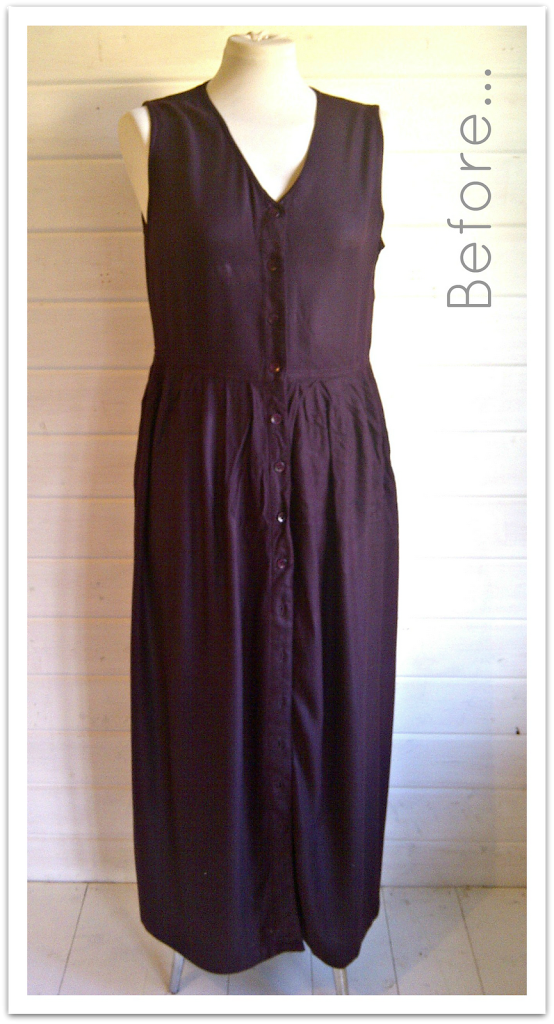
This dress has been in my refashion pile for eons. Like, 2 years! It was made from a beautiful aubergine shade of purple in a drapey brushed cotton. When deciding on items to refashion, I tend to look past the garment itself to the quality and quantity of fabric that there is to work with. This dress had an ankle length gathered skirt with no darts or such like. So once I had removed the skirt from the bodice, and removed the button placket down the centre, I was left with a really good amount of fabric to work with. One large rectangle from the back of the skirt; and 2 smaller rectangles harvested from the front skirt, cut from either side of the button placket. Out came my trusty kimono tee pattern, and a few minor pattern adjustments later, voila…

After lengthening the pattern slightly and reshaping the hem; I cut the front piece in one from the larger rectangle; then the back piece in two parts from the smaller rectangles. I simply added a CB seam allowance to my pattern, so the “new” top has a centre back seam.
The hem of this top is a “high/low” affair. Scooping down at the back and up at the front. The finished tee was a little plain even for my simple tastes! So I used some leftover scraps to add some little cuffs to the sleeves, finished off with buttons harvested from the original dress. Such a simple thing to do it turns out; (and a quick how to on that to follow later this week) but I think it really finishes this tee off nicely!
Pleased as punch with this one. So comfy to wear and I do love a bit of aubergine (eggplant to those of you across the pond!) Actually I can’t stand aubergine to eat. Bleurgh! But the colour officially rocks!

BTW, my photos, until we get some decent natural light, (in the UK in the winter? Fat chance!) are gonna be fuzzy and pretty crap. Just warnin’ ya!

cynthia rowley 2512, finished garments, Fitting, pattern adjustments

FO – Denim Cynthia Rowley 2512

10/15/12

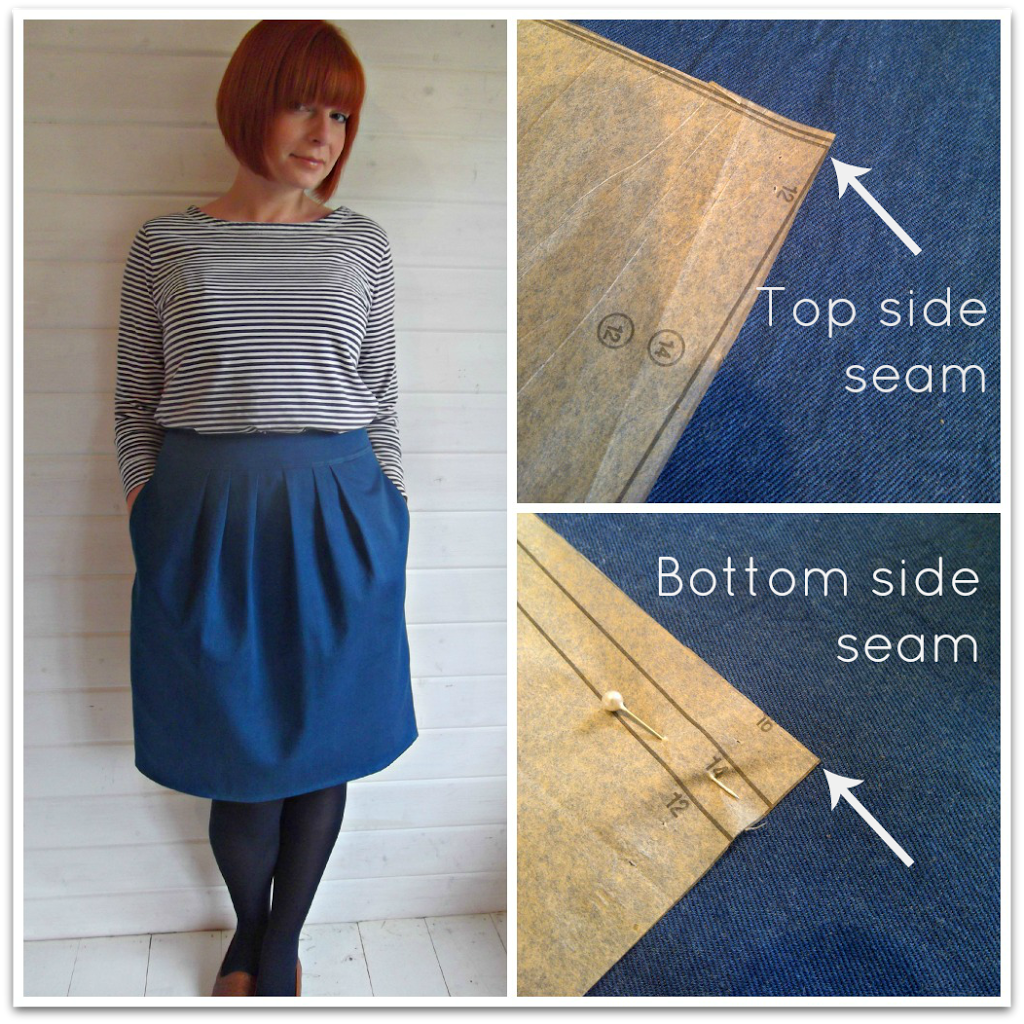
Further to my previous incarnation of this make, I thought I’d have another stab at it. I cut the previous one to a 14 at the waistband, and whilst it fit, it felt a little too generous. So I opted to cut this one at a 12 at the waistband. Apart from the size, there were a few tweaks that I wanted to make to this pattern. Whilst I liked the gathered element of this skirt, the “poofiness” around the abdomen and backside was a little too exaggerated for me to be entirely happy with it for everyday, practical wear. I wanted to tone it down a bit. So I tapered the side seams on both the front and back skirt pieces. Starting at a 16 at the hem and tapering to a 12 at the waist…

Anyone who has made this pattern will recognise the trapeze shape of the front skirt piece once it’s been cut out. All of that with along the top is converted to gathers (or pleats if you’re me!) and that translates to volume. Around the abdomen ladies! Not a place most of us want to add volume! At least not to the extremes of this pattern, and certainly not with my mummy tummy! Essentially, all I did was tone the angle down a bit. The red lines/arrows mark where I cut so you get an idea of what I removed from the original pattern.  You can see that this has the effect of removing width  at the waist; width that would otherwise have been gathered and translated into “poofiness”…..

I made this adjustment to both the front and back pattern pieces. So when all told, it added up to around 4″ of overall gathering removed from around the abdomen area. Which feels so much more flattering (and I’m told looks so too :). This new version still retains that “tulip” shape that originally drew me to the design, but in a much more subtle, and hopefully more flattering way.
On the downside, despite being prewashed and seeming really good; this denim actually creases like hell during proper wear. But I’m hoping a few more washes will soften it up some!
Overall though, pretty pleased 🙂
Have you tried this pattern and found it too “poofy” for your liking? Is “poofiness” even a word?!

Portia
Follow
Sewbox

© Copyright 2026. Portia Lawrie. All Rights Reserved. Managed by WordPress Web Dev Cornwall .